For years, the search playbook looked fairly linear:
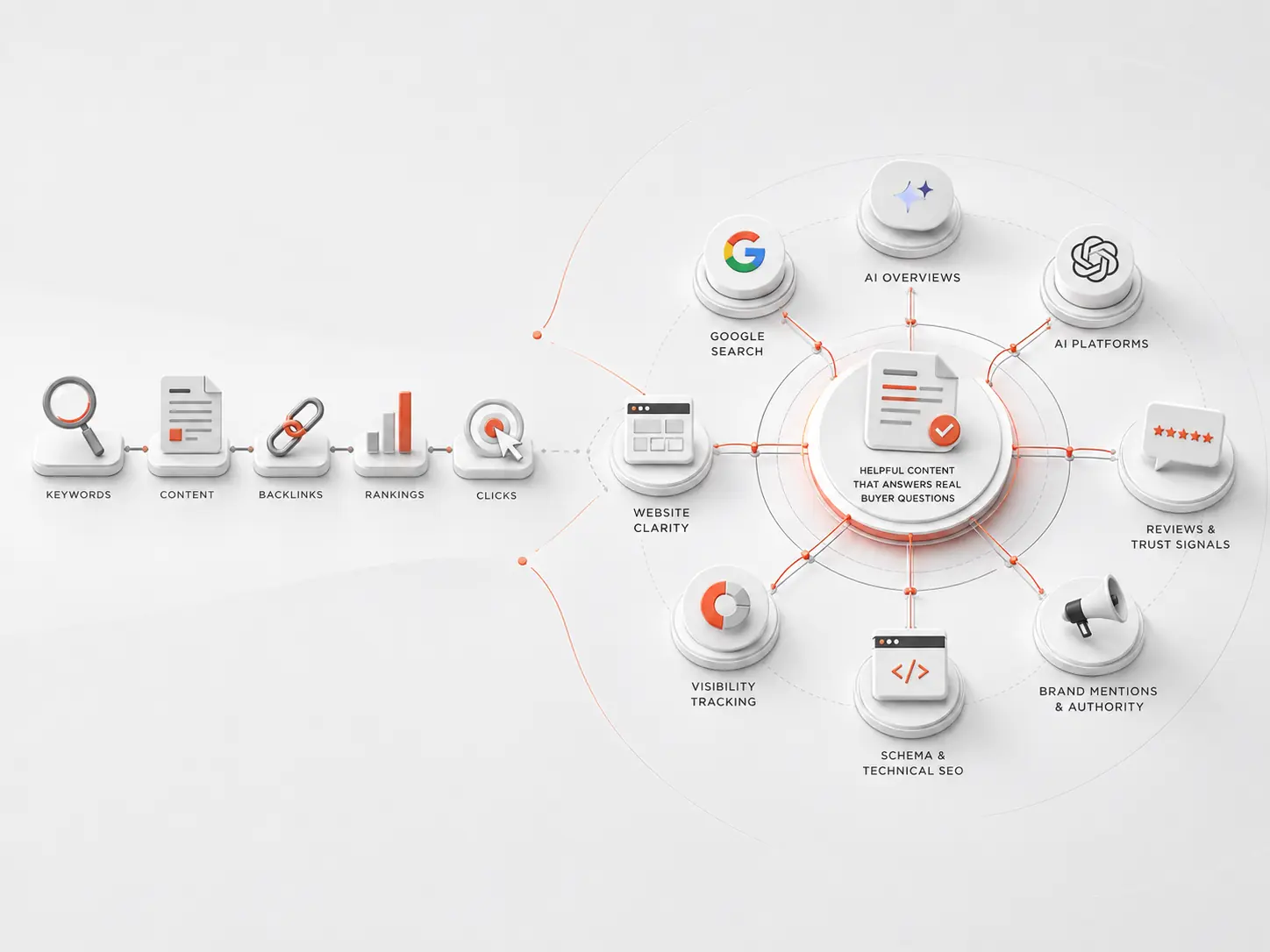
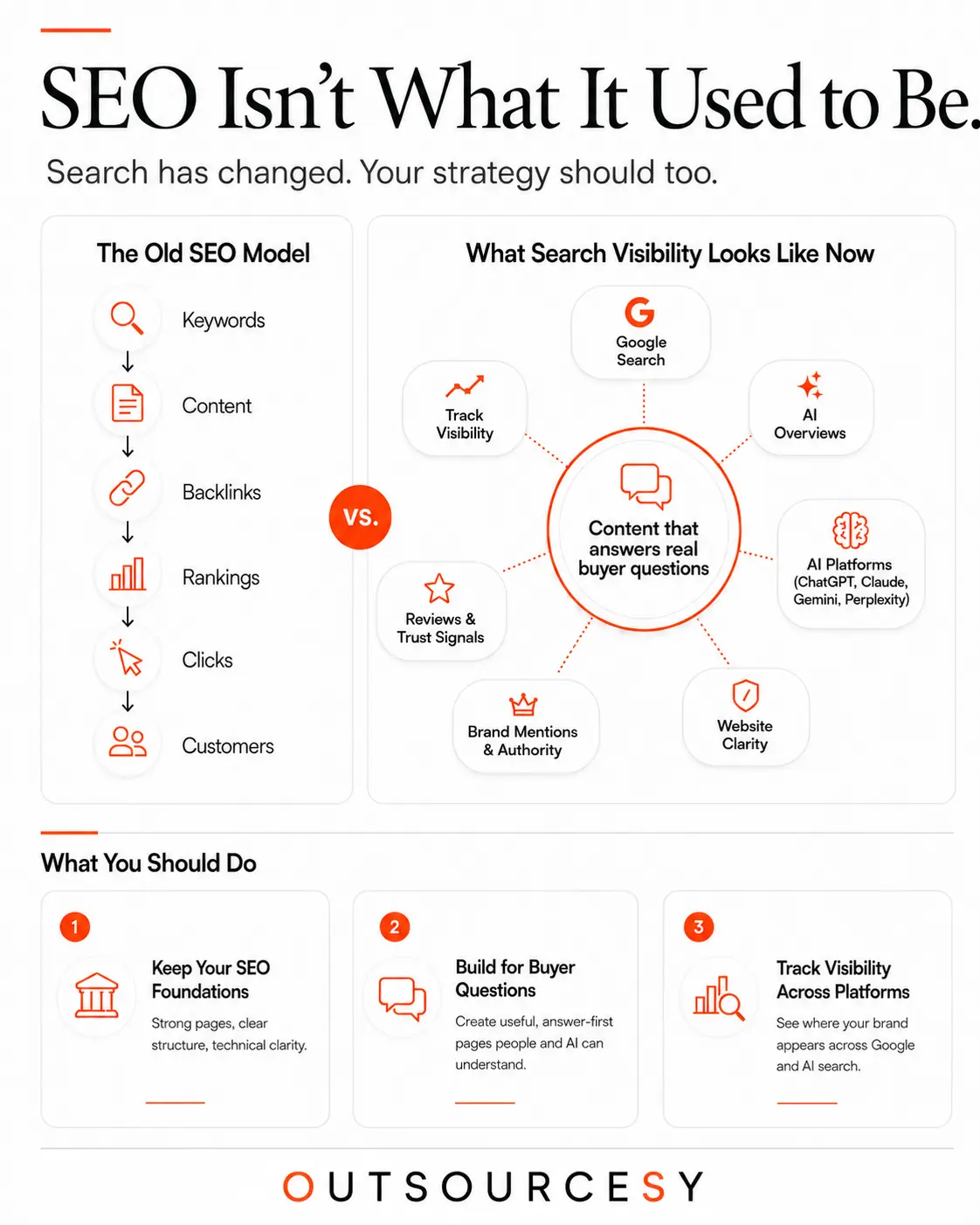
Keywords → Content → Backlinks → Rankings → Clicks → Customers
That model was never quite as simple as it looked, but it gave companies a reasonably clear way to think about organic visibility. Create useful pages. Optimize them for the searches that matter. Earn authority. Rank well. Get the click. That system still exists. It just no longer operates by itself.
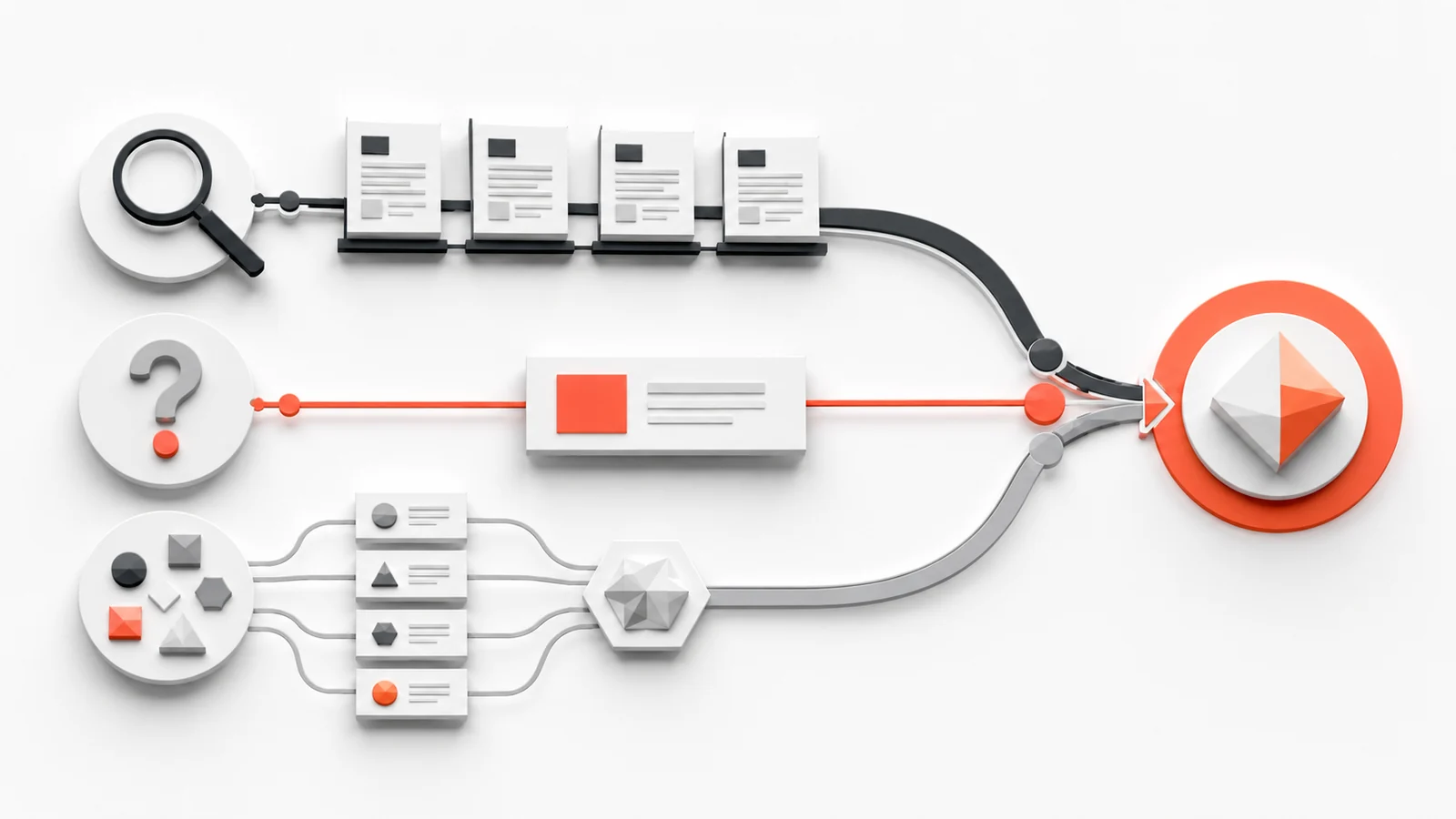
Today, a prospective customer might start with Google, ask ChatGPT for recommendations, compare companies in Claude, use Gemini to understand a category, check sources in Perplexity, encounter a Google AI Overview, read reviews, visit several websites, and return days later through branded search.
Search has become a buyer discovery system, not simply a list of ten blue links.
And that changes what companies need to optimize for.
Traditional SEO is still the foundation
There is a temptation to treat AI search as the replacement for SEO. That is the wrong conclusion.
AI systems still need information to retrieve, interpret, compare and reference. Search engines still need to crawl and understand websites. Buyers still land on service pages, articles, comparison pages, provider profiles, product information and company websites.
The fundamentals remain important:
- Clear site architecture
- Useful, substantive content
- Strong service and category pages
- Technical crawlability
- Internal linking
- Relevant authority and backlinks
- Accurate titles and metadata
- Helpful structured data
- Clear expertise and authorship
- A website that actually answers what buyers want to know
The difference is that those assets now serve more than traditional rankings.
A strong service page might rank in Google. It might also become a source an AI system retrieves when answering a buyer's question. It might help a search engine better understand what the company does. It might give a prospective customer the evidence they need after discovering the company somewhere else.
That is why abandoning SEO to chase “AI optimization” would be a mistake. The foundation did not disappear. The environment around it expanded.
Ranking first is no longer the same as owning the buyer journey
A high Google ranking is valuable. But it does not guarantee the same thing it once did. Search results increasingly contain more than conventional organic listings: maps, videos, forums, shopping results, featured answers, AI Overviews and other search experiences.
At the same time, some buyers are beginning their research somewhere other than Google entirely.
They may ask:
- What are the best companies for this?
- Who specializes in this problem?
- Compare these three providers.
- What should I look for before hiring someone?
- Which company has the strongest reputation?
- What are the alternatives to this vendor?
- Who serves my area?
- Which provider is best for a company like mine?
Those questions may happen in ChatGPT, Claude, Gemini, Perplexity, Google AI Mode or another research environment.
That means companies now have to think beyond:
Where do we rank?
They also need to ask:
- Where do we appear when buyers research this problem?
- How are we described?
- What sources are influencing that answer?
- Are competitors easier to discover or understand?
- If someone finds us, do they have enough reason to trust us?
That is a much broader strategic problem. And it is why OutsourceSy treats search and AI discoverability as connected parts of the same buyer journey rather than separate marketing channels.
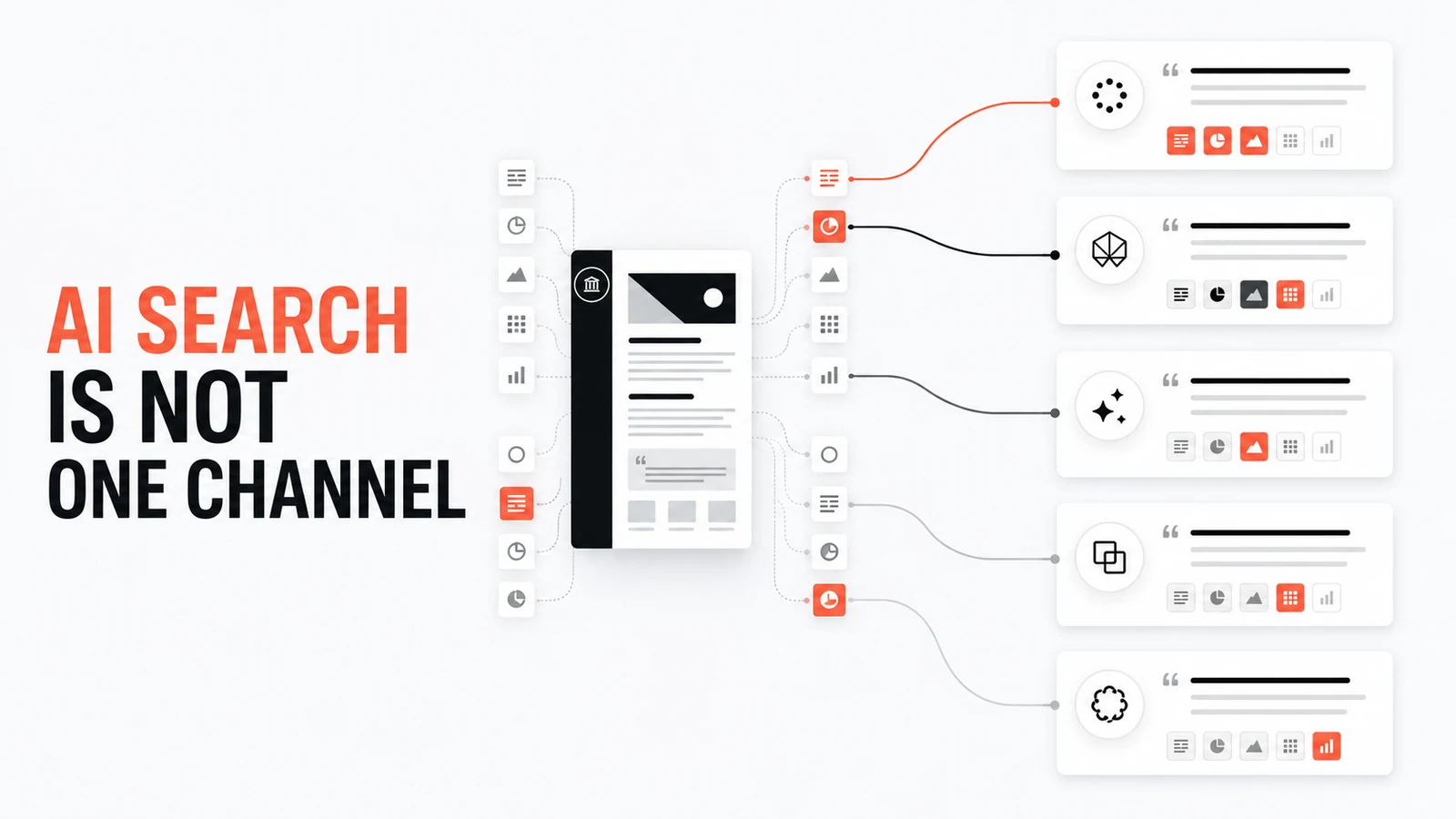
AI search is not one channel
Another mistake is treating “AI visibility” as though there were one universal AI search ranking. There isn't. ChatGPT, Claude, Gemini, Perplexity and Google's AI search experiences can use different retrieval systems, sources, signals and methods for generating answers. A company that appears prominently in one system may be absent from another.
One platform may rely heavily on a company's own website for a particular question. Another may surface a trade publication. Another may reference Reddit, directories, review platforms, news coverage or competitor content. Another may produce an answer without citing the company at all. So the goal should not be: “Get ranked in AI.”
There is no single AI ranking to win.
The related analysis AI Search Is Not One Channel: Why Your Brand Appears in ChatGPT but Not Perplexity explains why citation sources and visibility can differ across platforms.
The more useful question is:
Does the digital evidence surrounding the business make it easy for different search and AI systems to understand what the company does, when it is relevant and why it is credible?
That evidence can come from many places:
- The company's website
- Service and product pages
- Expert biographies
- Reviews
- Industry publications
- Original research
- Helpful articles
- Directories
- Case studies
- Third-party mentions
- Structured data
- Consistent business information
- Comparison and educational content
Visibility in one AI platform does not guarantee visibility in ChatGPT, Claude, Gemini, Perplexity or Google's AI search experiences. That multi-platform principle is central to OutsourceSy's current search and AI discoverability approach.
Content has to do more than target keywords
Keyword research is still useful. But a page created only because a keyword has search volume is increasingly inadequate. Modern search content has to help answer the real questions surrounding a buying decision. Suppose someone is looking for a complex professional service.
They may want to understand:
- What does this service actually include?
- Who is it for?
- Who is it not for?
- What does the process look like?
- How much does it typically cost?
- What affects pricing?
- What credentials matter?
- What are the risks?
- How does one approach compare with another?
- What should I ask before choosing a provider?
- What happens after I contact the company?
Companies that answer these questions clearly create something more useful than “SEO content.” They create source material for buyer research.
That content can help traditional search engines understand the page. It can give AI systems clearer information to retrieve. And most importantly, it helps the actual person trying to make a decision. That last part matters. The human buyer should remain the primary audience.
Optimizing for AI does not mean writing robotic pages designed to manipulate language models. It means making expertise, evidence and information unusually clear.
Authority is becoming harder to fake
For a long time, SEO conversations about authority focused heavily on backlinks. Links still matter. But buyer trust and machine understanding are both influenced by a broader body of evidence.
A company claiming expertise on its own website is one signal. A company with detailed expert profiles, credible reviews, case studies, original analysis, consistent third-party references, well-developed service pages and clear organizational information presents a much stronger picture.
This is especially important in categories where trust heavily influences the purchase:
- Healthcare
- Professional services
- Education
- Technology
- Financial services
- Complex B2B services
- High-consideration purchases
In those environments, being discovered is only the first hurdle. The buyer still has to believe you. That is why search visibility, reputation, expertise, website credibility and conversion should not be treated as unrelated disciplines. They affect the same decision.
Technical SEO and structured data still have a job
Schema markup is another area where the AI-search conversation tends to become exaggerated. Structured data is useful. It can help machines identify relationships between organizations, people, services, articles, locations and other entities. But schema does not manufacture authority.
Adding Organization or Service markup to a weak website does not suddenly make that company the best answer. The same principle applies to technical SEO generally. Clean technical foundations help search systems access and interpret information. They are infrastructure. They are not a substitute for having something valuable to say.
The strongest strategy combines both:
Make the information technically accessible and make the information worth retrieving.
Businesses now need to measure more than rankings
Traditional SEO measurement is relatively mature.
Companies can track:
- Rankings
- Impressions
- Organic clicks
- Landing-page traffic
- Conversions
- Branded searches
- Leads
- Revenue
AI visibility is less tidy. Outputs can change. Prompts matter. Platforms behave differently. Sources change. Personalization and context can influence results.
That means AI visibility should be treated as an observational signal, not a perfectly stable ranking report.
Useful questions include:
- Does the brand appear for important buyer questions?
- Which competitors appear?
- How is the business described?
- Which sources are cited?
- Are those sources accurate?
- Are important services understood?
- Does visibility differ by platform?
- Are competitors supported by stronger evidence?
- Are there recurring gaps that the company can realistically improve?
The goal is not to produce a flashy “AI visibility score” with false precision. The goal is to learn something that helps the business make better decisions.
This is consistent with OutsourceSy's Buyer Discovery Audit, which examines the research experience across traditional search, multiple AI platforms, websites, trust signals, competitors and other evidence rather than treating AI outputs as deterministic rankings.
So what should companies actually do?
The answer is not to abandon SEO.
It is not to rename every SEO task “GEO.”
The growing vocabulary can make ordinary work sound like five separate disciplines. In practice, most of the value still comes from a shared foundation: accessible pages, clear answers, credible evidence, recognizable entities and a website that helps a buyer make a decision. New labels are useful only when they identify a real gap that the existing search program is not addressing.
And it is not to create hundreds of shallow pages hoping an AI system will notice.
A stronger approach looks like this:
Keep the SEO foundation strong
Make sure important pages can be crawled, understood and found.
Build clear source-of-truth content
Explain your services, expertise, audiences, locations and differentiators clearly.
Answer the questions buyers genuinely ask
Not just keywords. Questions, objections, comparisons and decisions.
Strengthen the evidence around the business
Reviews, expertise, case studies, citations, third-party references and reputation all contribute to trust.
Make entities and relationships clear
Help systems understand the organization, its experts, services, locations and content.
Evaluate multiple discovery environments
Google is important. So are ChatGPT, Claude, Gemini, Perplexity and Google's emerging AI search experiences when they are relevant to your buyers.
Track what changes
Search and AI systems evolve. Competitors improve. Buyer behavior changes. Your strategy should respond accordingly through continued monitoring and improvement.
The new SEO question
The old question was:
How do we rank higher?
That question still matters. But it is no longer sufficient.
The better question for 2026 is:
When qualified buyers research the problems we solve, how easy are we to find, understand, trust and choose?
That question includes SEO. But it also includes AI search, content, website structure, authority, reviews, entity clarity, buyer education and the evidence people encounter before they ever speak to your company. SEO isn't dead. It also isn't what it used to be. The companies that adapt will not be the ones chasing every new acronym or AI tactic.
They will be the ones building a stronger, clearer and more credible discovery system around the business.
Because being visible is only the beginning. The real objective is being found by the right buyer, trusted when they investigate, and chosen when they are ready to act.
A PRACTICAL STARTING POINT
See where your buyer discovery system is breaking down.
Qualified buyers may encounter your company through Google, AI search, reviews, third-party sources and your own website before they ever contact you. A Buyer Discovery Audit helps identify where that journey becomes harder than it should be and what deserves attention first.
Request a Discovery Review