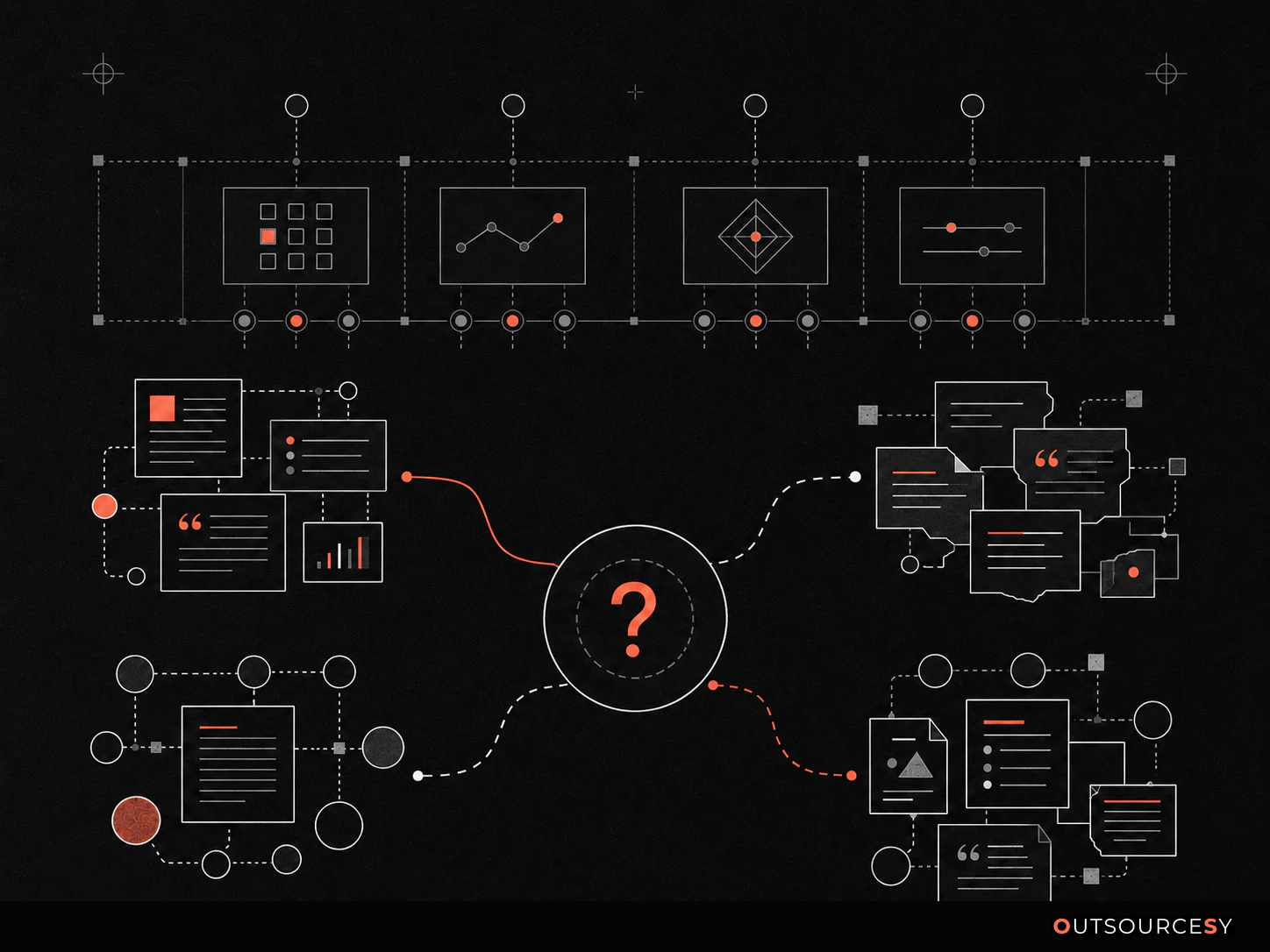
That is not necessarily a tracking error. It reflects a basic reality of AI search: there is no single, universal set of AI search results.
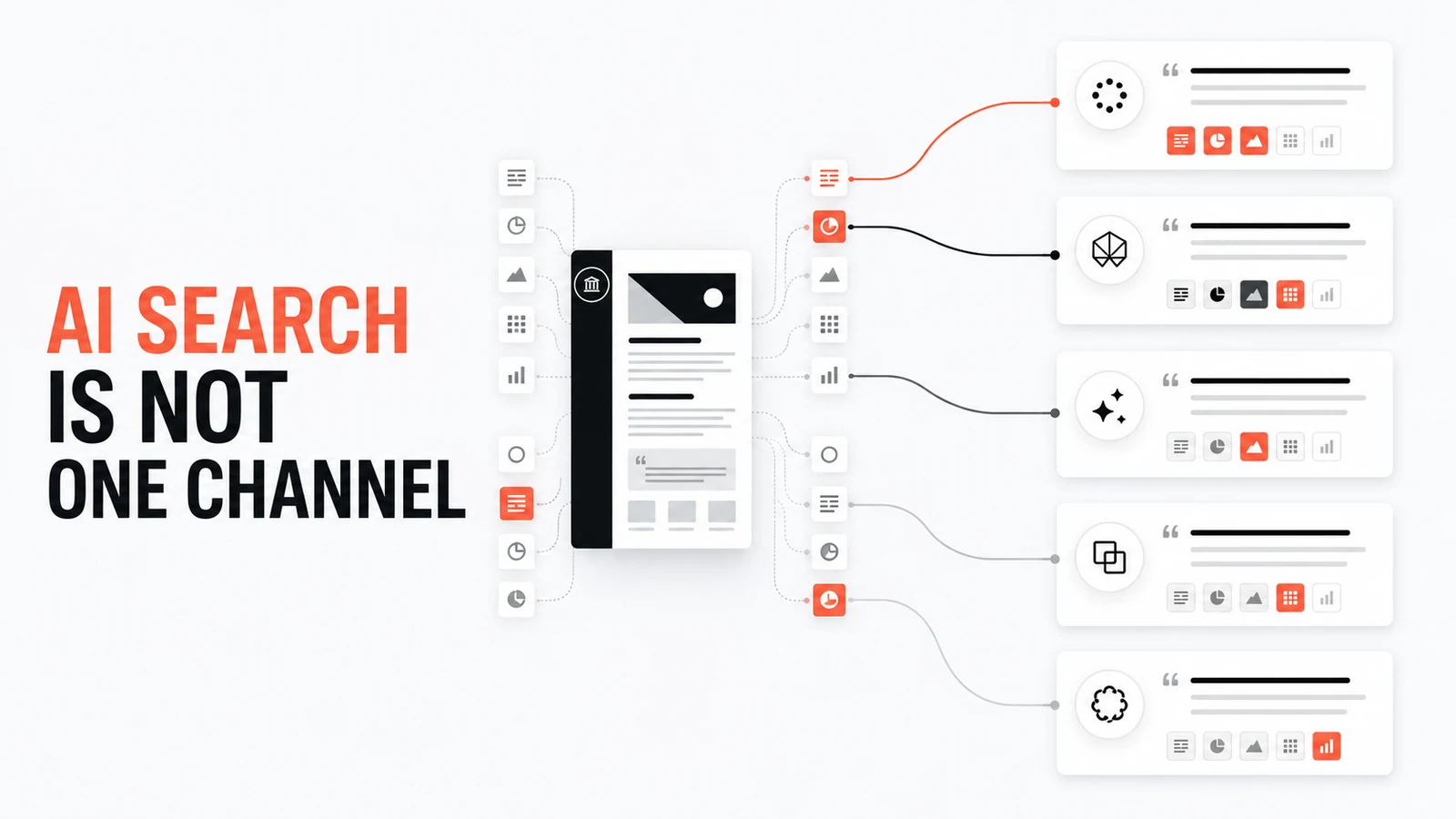
Each platform decides how to interpret a question, where to retrieve supporting information, which sources to trust and how to assemble an answer. The result is a fragmented discovery environment in which visibility on one platform does not automatically carry over to another.
A large Ahrefs study illustrates the difference: in one September 2025 U.S. dataset, citations in Google AI Overviews and Google AI Mode overlapped by only 13.7%, even though the paired answers had an average semantic-similarity score of 86%. Those figures describe that dataset, not a permanent rule for every query or market.
The practical lesson is not that every business needs five separate content strategies. It is that businesses need to stop treating “AI visibility” as one ranking position or one score.
Why the same question produces different sources
Traditional search results already vary by location, device, intent and query wording. AI-generated answers add more variables.
- Break one question into several related searches
- Retrieve information from different indexes or data partners
- Favor different source types for different questions
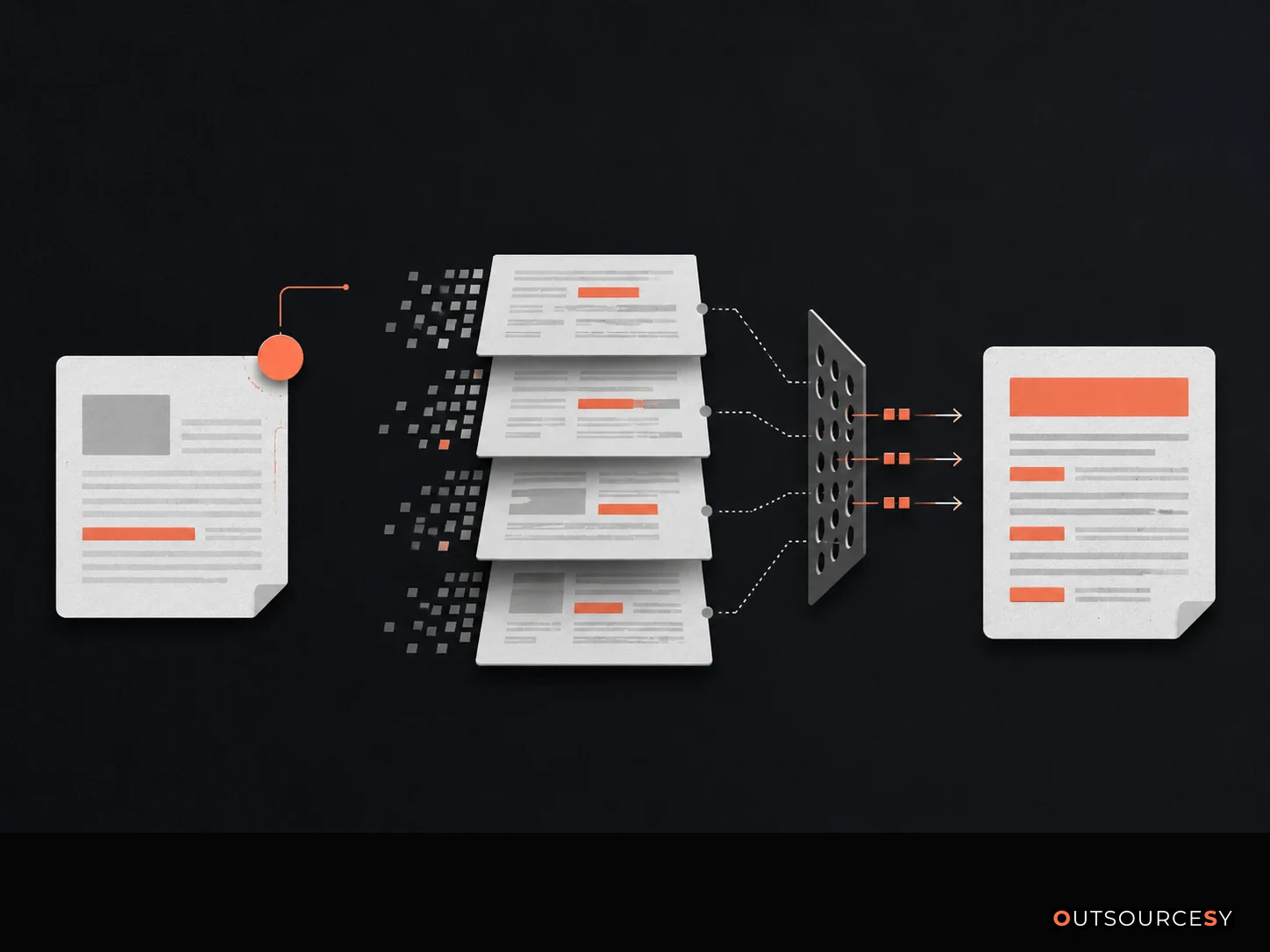
- Select individual passages rather than relying on one complete page
- Incorporate freshness, authority, relevance and corroboration differently
- Generate a different answer when the same prompt is repeated
A better way to frame the visibility question
Google confirms that its AI search experiences may use a technique called query fan-out, which runs multiple related searches across subtopics and data sources. This helps explain why two systems can give similar answers while citing different pages.
It also explains why a simple question such as “Does our company appear in AI search?” is incomplete.
The more useful questions are:
- Which platform?
- For which buyer question?
- Under what location, context and wording?
- Was the company mentioned, recommended or cited?
- Which competitors appeared instead?
- Which sources shaped the answer?
Citation, mention and recommendation are not the same thing
AI visibility is often discussed as if every appearance has equal value. It does not.
A brand can appear in at least three materially different ways:
- Citation: The platform links to a page from the company’s website or another source associated with the company.
- Mention: The company is named in the answer but is not linked as a supporting source.
- Recommendation: The company is included in a shortlist, comparison or suggested next step.
Why the distinction matters
A citation can create referral traffic and signal that the platform relied on the source. A mention can increase familiarity without producing a click. A recommendation may influence a buying decision even when the company’s own website is not cited.
That means a useful AI visibility review should measure more than links. It should examine whether a business is understood correctly, included in relevant consideration sets and supported by enough credible information to be trusted.
What current citation research actually tells us
Citation studies are useful, but they should be interpreted carefully.
Ahrefs analyzed 540,000 September 2025 U.S. query pairs for citation behavior across Google AI Mode and AI Overviews. The same URLs appeared in both experiences only 13.7% of the time. A separate 730,000-pair analysis produced an average semantic-similarity score of 86%. The snapshot suggests that the two surfaces can reach comparable conclusions using different evidence, but it does not establish how every future result will behave.
Another vendor analysis by Profound examined 680 million citations tracked across ChatGPT, Google AI Overviews and Perplexity from August 2024 through June 2025. Within that dataset, Wikipedia had the highest overall citation share for ChatGPT, while Reddit led for Google AI Overviews and Perplexity. Because the data came from Profound's tracked prompts and product, it should be read as a large observational sample rather than a complete census of each platform.
These findings do not prove a permanent formula such as “ChatGPT always wants Wikipedia” or “Perplexity always wants Reddit.” Platform behavior changes. Source preferences also vary by industry, prompt type, geography and the timing of the search.
The durable conclusion is narrower and more defensible: different AI search experiences frequently draw from different source pools, so performance must be observed separately.
The mistake: creating five disconnected optimization strategies
The obvious reaction is to create a separate playbook for ChatGPT, Perplexity, Gemini, Claude and Google’s AI search experiences.
That can become wasteful very quickly.
Most businesses do not need five versions of the same article or a stream of platform-specific content written to chase volatile citation patterns. They need a strong underlying information system that makes the business easy to crawl, understand, verify and compare.
That shared foundation includes:
- Clear descriptions of services, buyers and locations
- Pages that answer real buyer questions directly
- Consistent company and expert information across the web
- Evidence-backed claims and identifiable sources
- Relevant reviews and third-party validation
- Strong internal linking and logical information architecture
- Accessible pages with sound technical SEO
- Structured data where it accurately represents visible content
- Original expertise, examples and analysis worth referencing
Foundation first, adjustment second
These elements support traditional search, AI retrieval and human decision-making at the same time.
Platform-specific work should come afterward. It is an adjustment layer, not the entire foundation.
How to find which sources AI search platforms use
Source analysis starts with visible evidence, not an assumption about a platform’s hidden system. When a response provides citations, record the cited page and source domain. When it provides only a mention or recommendation, note that no visible citation was supplied rather than inventing one.
The useful comparison is not simply which domain appears most often. It is which source supports which claim, whether the source is accurate, how often the pattern repeats and whether the evidence is commercially relevant to the buyer’s question.
1. Map the questions buyers actually ask
Start with the research journey, not the platform.
Identify questions buyers ask while recognizing a problem, comparing approaches, evaluating providers and deciding whom to contact. Include branded and non-branded questions, category comparisons, cost and risk questions, location-based searches and questions that reveal hesitation.
The goal is not to produce an enormous keyword list. It is to identify the questions that can materially affect whether your business enters the buyer’s consideration set.
2. Establish a platform-by-platform baseline
Run a controlled set of representative prompts across the platforms your buyers are likely to use. Record:
- Whether your company appears
- How it is described
- Whether the description is accurate
- Whether it is cited, mentioned or recommended
- Which competitors appear
- Which sources are cited
- Whether the answer changes across repeated tests
3. Inspect the source gap
Do not reduce this to one universal AI visibility score. A single score can hide the exact gaps the analysis is supposed to reveal.
If competitors appear and your business does not, examine the evidence available to the platform. Why Is My Business Not Showing Up in ChatGPT? shows how to separate an observable result from a hypothesis about its cause.
Is the competitor supported by clearer service pages? More detailed expert profiles? Better reviews? Stronger association with the topic? More independent coverage? A useful comparison page? A video, directory profile or community discussion that answers the question directly?
The problem may not be a missing keyword. It may be missing proof.
4. Strengthen the shared information foundation
Fix the issues that affect discoverability across channels first. Clarify ambiguous services. Improve thin pages. Connect related topics. Make important facts consistent. Add original evidence. Strengthen authorship and organizational identity. Remove technical barriers that prevent reliable crawling or indexing.
This is where traditional SEO, answer engine optimization and buyer-journey strategy overlap.
5. Make targeted platform adjustments
Once the foundation is sound, respond to observable platform-specific gaps.
That may mean keeping time-sensitive material current, producing a useful video, earning credible third-party coverage, improving entity consistency, adding a direct comparison resource or contributing genuine expertise to an industry community.
The adjustment should follow evidence. Do not create content for Reddit, YouTube or any other platform merely because a broad citation study found that source frequently represented in its dataset.
6. Measure patterns, not isolated screenshots
AI answers are variable. One prompt on one day is not a reliable performance benchmark.
Track a stable set of commercially relevant questions over time. Separate results by platform. Note changes in mentions, citations, recommendations, competitors and source selection. Connect that visibility to referral traffic, branded search, qualified inquiries and sales conversations where possible.
The objective is not to collect flattering screenshots. It is to understand whether the business is becoming easier to find, verify and choose.
What businesses should do now
You do not need to optimize equally for every AI platform.
Prioritize based on where your buyers conduct research and how close each question is to a commercial decision. A professional-services firm may care most about Google, ChatGPT and Perplexity. A company in a visually researched category may place more weight on Google’s multimodal results and YouTube. A technical B2B company may need stronger visibility in detailed comparison and evaluation prompts.
The right mix depends on the buyer journey.
What should remain consistent is the operating principle:
AI search is not one channel, and citation visibility is not one ranking. Businesses that understand that distinction will make better decisions than those chasing a generic GEO checklist.
Build one credible information foundation. Measure each meaningful discovery surface separately. Fix the gaps that affect real buying decisions.
See where your discoverability breaks down
The OutsourceSy Buyer Discovery Audit examines how a business appears across Google, AI-generated answers, its website, reviews, third-party sources and the broader buyer research journey. The goal is not to manufacture an AI visibility score. It is to identify where qualified buyers struggle to find, understand, trust or choose the business, then prioritize what to fix.
Learn about the Buyer Discovery Audit