Search visibility is changing.
For years, many businesses treated SEO as the whole game: rank on Google, get traffic, and let the website do the rest.
That model is no longer complete.
People still use search engines, but they are also asking full questions, expecting direct answers, using AI tools for research and recommendations, and judging businesses across multiple digital touchpoints before deciding what to do next.
In other words, ranking matters. But ranking alone is no longer enough.
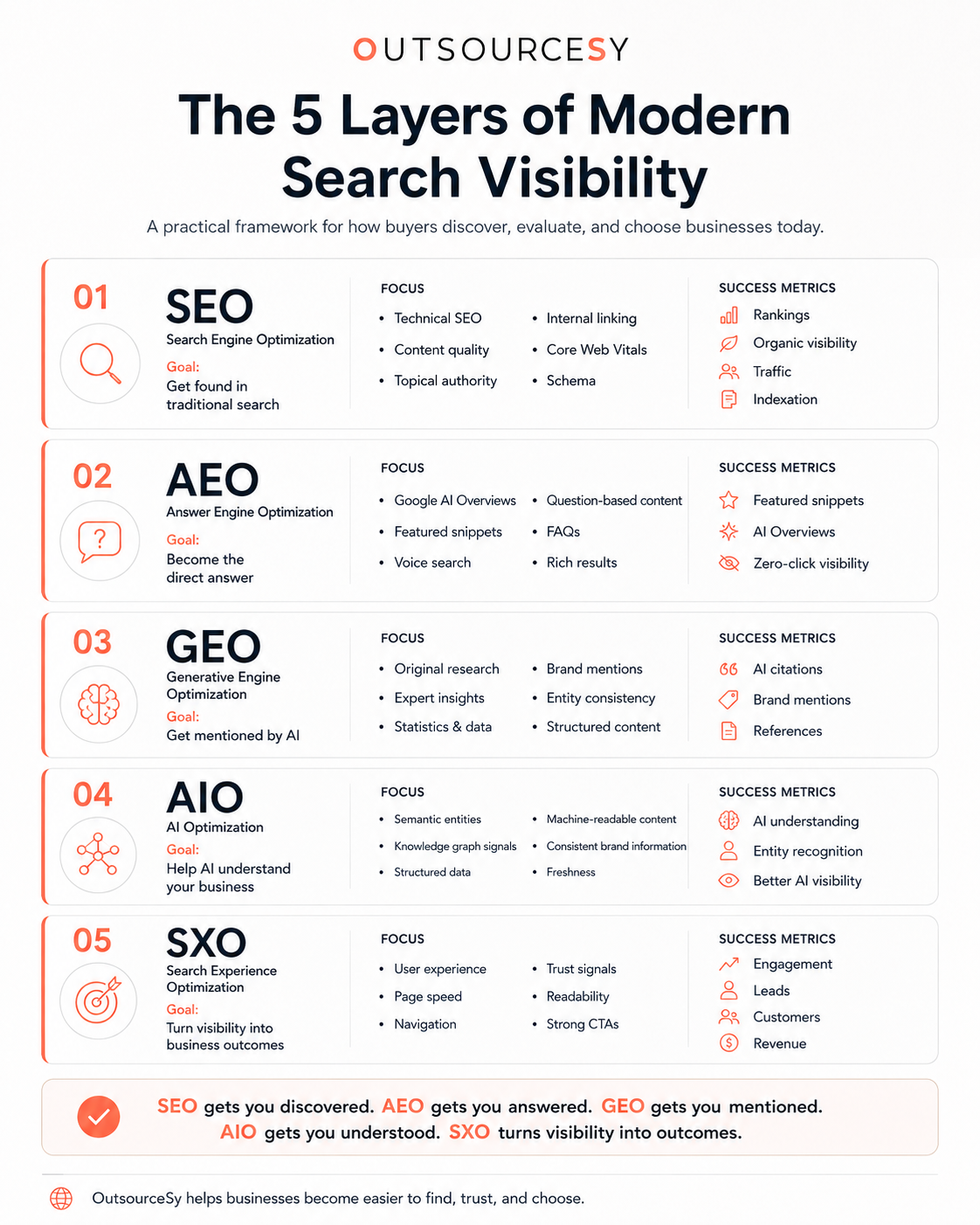
A practical way to think about the modern search environment is through five connected layers:
SEO → AEO → GEO → AIO → SXO
This is not a universally standardized official taxonomy, and it is not about replacing SEO. It is a practical framework for understanding how the broader discovery environment now works and why visibility needs to extend beyond traditional rankings.
1. SEO: Search Engine Optimization
SEO is still the foundation.
If a business cannot be crawled, indexed, and ranked properly, the rest of the system becomes harder. Traditional organic search still matters because Google remains one of the main ways people discover companies, services, products, and information.
At its core, SEO is still about:
Get Crawled → Get Indexed → Get Ranked
What it involves
Key areas include:
- Technical SEO
- Content quality
- Topical authority
- Internal linking
- Core Web Vitals
- Schema and structured data
- E-E-A-T signals
- Quality backlinks
What it helps accomplish
SEO helps a business show up when someone searches directly in Google or another traditional search interface.
Useful success indicators may include:
- Rankings
- Organic visibility
- Organic traffic
- Indexed pages
- Relevant non-branded discovery
The practical point
SEO should now be viewed as the starting point, not the entire strategy.
2. AEO: Answer Engine Optimization
Search engines are increasingly becoming answer engines.
Instead of requiring users to click through multiple results and assemble an answer themselves, search interfaces increasingly provide direct responses.
AEO focuses on making content easier to understand, extract, summarize, and present as a useful answer.
Relevant answer experiences
Relevant areas may include:
- Google AI Overviews
- Featured snippets
- Question-based content
- FAQs
- Voice-search responses
- Rich results
What effective answer content looks like
Effective AEO content tends to be clear, direct, structured, useful, and easy to interpret.
This does not mean reducing every page to short, robotic answers. It means structuring content so that both people and systems can quickly understand what question is being answered.
Useful success indicators may include:
- Featured snippets
- Visibility in AI Overviews
- Zero-click visibility
- Stronger answer extraction
3. GEO: Generative Engine Optimization
AI platforms are now part of the research and discovery journey.
Buyers may use ChatGPT, Gemini, Perplexity, Claude, Copilot, and Google AI experiences to ask for recommendations, comparisons, summaries, explanations, and next-step guidance.
GEO focuses on improving the likelihood that a brand, source, expert, or business is visible and relevant within AI-generated responses.
This is not identical to traditional SEO.
Different AI systems may use different sources, retrieval methods, evidence signals, citation behavior, and recommendation logic. Visibility in one platform does not guarantee visibility in another.
What can support generative discovery
GEO may benefit from:
- Original research
- Useful statistics and data
- Expert insights
- Brand mentions
- Entity consistency
- Fresh information
- Structured content
- Trustworthy third-party corroboration
What to measure carefully
Useful success indicators may include:
- AI citations
- AI mentions
- Brand references
- Recommendation visibility
- Inclusion in comparison or evaluation responses
A necessary boundary
No one can guarantee AI citations or recommendations. The useful work is building clearer, more credible evidence that can support accurate representation across different research environments.
4. AIO: AI Optimization
AIO is a useful way to describe another important part of modern discovery: AI systems need to understand your business before they can represent it accurately.
If a company’s brand information is inconsistent, unclear, incomplete, or scattered, AI systems may misunderstand what the business does, who it helps, where it operates, what services it provides, or what expertise it has.
AIO focuses on making a business easier for machines to interpret and connect.
What it can involve
This can involve:
- Semantic entity clarity
- Knowledge graph signals
- Structured data
- Machine-readable content
- Consistent brand information
- Content freshness
- Clear page relationships
- Explicit source-of-truth content
What to look for
Useful success indicators may include:
- Stronger entity recognition
- More accurate AI descriptions
- Better alignment between the business and relevant topics
- Improved AI visibility over time
A useful explanatory layer
AIO is not a universally standardized industry discipline. Here, it is a practical label for the work of reducing ambiguity so machines can better interpret a real business and its relationships.
5. SXO: Search Experience Optimization
Traffic is not the finish line.
A visitor arriving from Google or an AI system still needs to understand the business, trust it, and take the next step.
SXO connects search visibility with user experience and conversion.
The questions it asks
SXO asks:
- What happens after someone lands on the website?
- Is the page easy to understand?
- Does the site create trust?
- Is the next step obvious?
- Does the experience help the visitor move forward?
What it can involve
SXO may involve:
- User experience
- Page speed
- Navigation
- Readability
- Trust signals
- Strong calls to action
- Mobile experience
- Conversion-rate optimization
What business outcomes may show
Useful success indicators may include:
- Engagement
- Qualified inquiries
- Form submissions
- Bookings
- Sales
- Revenue where attribution is supportable
How this applies in real life
The five layers become easier to understand when you look at how they can work together in a real buyer journey. Consider a hypothetical healthcare practice that offers grief counseling.
This is an illustrative example, not a claim about a specific client result.
SEO gets the practice discovered
SEO helps search engines crawl, index, and rank the practice’s grief-counseling pages for relevant searches.
A prospective client might search “grief counseling near me” or “online grief counseling in Florida.”
Strong technical foundations, useful service content, internal linking, and clear page structure help the practice become discoverable.
AEO helps the practice answer specific questions
A prospective client may search “How do I know if grief counseling could help me?”
Clear, question-based content can help the practice provide a useful direct answer through search features and answer-driven interfaces.
GEO helps the practice appear during AI-assisted research
A person may ask an AI platform “What should I look for when choosing a grief counselor?” or “Find grief counseling options for adults in Florida.”
GEO focuses on whether the practice has enough useful, credible, and corroborated information to potentially become part of that research process. Optimization does not guarantee inclusion.
AIO helps AI systems understand the practice
The practice’s website and external profiles should make it clear:
- What services it offers
- Who provides them
- Provider credentials
- Who the services are for
- Whether services are in-person or telehealth
- Where the practice serves clients
SXO helps turn visibility into an inquiry
Discovery only matters if the website helps the visitor move forward.
Once the person lands on the grief-counseling page, they should be able to quickly understand:
- Whether the service fits their situation
- Who the provider is
- Whether telehealth is available
- How payment or insurance works where applicable
- What happens during the first appointment
- How to inquire or schedule
Why the five layers matter together
The future of search is not about choosing one of these approaches and ignoring the others.
- SEO helps you get discovered.
- AEO helps your content become the answer.
- GEO helps your brand become visible in AI-generated research.
- AIO helps AI systems understand who you are and what you do.
- SXO helps turn visibility into business outcomes.
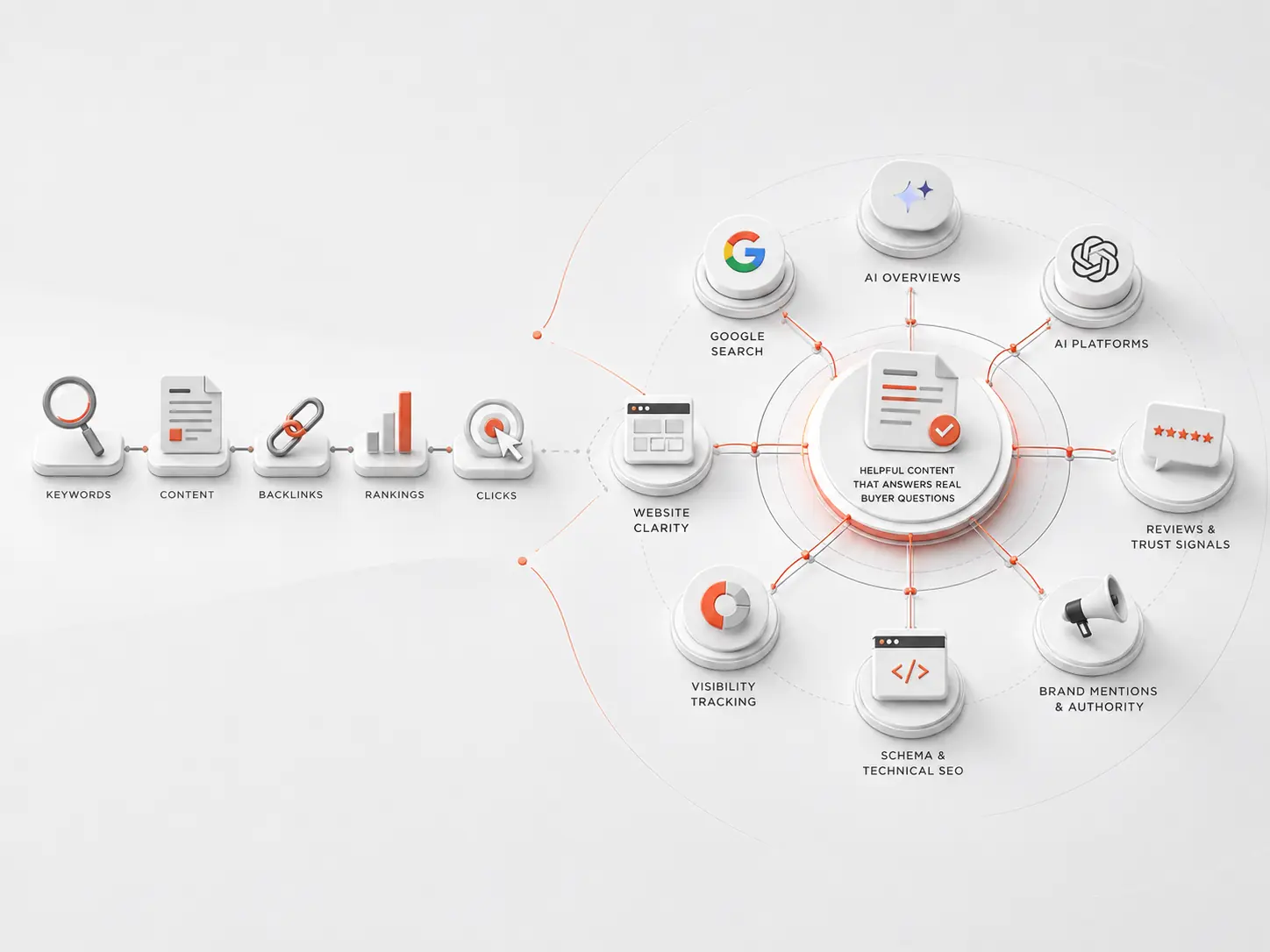
A connected discovery system
A buyer may first encounter a company through Google, ask an AI tool for more information, compare several websites, review third-party evidence, and then decide whether to contact the business.
That is no longer a single-channel journey. It is a connected discovery system.
OutsourceSy evaluates that system through Discover → Understand → Trust → Choose → Respond → Convert, with Find → Trust → Choose as the public-facing simplification.
What businesses should do now
Most companies do not need five disconnected optimization programs.
They need to understand where the actual constraint exists.
- Can the right buyers find us in traditional search?
- Do our pages answer the questions people are actually asking?
- Are AI systems mentioning or describing us accurately?
- Is our business information clear and consistent?
- Do third-party sources reinforce our expertise and legitimacy?
- Does our website help visitors understand, trust, and take action?
- Can we measure what happens after discovery?
Diagnose before prescribing
If several of these are weak, the problem is probably broader than “we need more SEO content.”
The real issue may be discovery, authority, business clarity, website experience, conversion, or a combination of them.
OutsourceSy’s Buyer Discovery Audit is designed to diagnose where buyers struggle across discovery, understanding, trust, choice, conversion, and related handoffs before deciding what should be fixed first.
Final takeaway
Modern search is no longer just about rankings.
It is about whether your business can be found, understood, trusted, and chosen across search engines, AI systems, websites, reviews, and the broader buyer-research journey.
The companies that adapt will not simply optimize for algorithms. They will build clearer, more credible digital systems for both humans and machines.
A practical next step
Not sure where your visibility system is breaking down?
OutsourceSy helps businesses identify whether the real constraint is search visibility, AI discovery, trust, website clarity, conversion, or another part of the buyer journey, then prioritize what should be fixed first.
Discuss Your Growth Challenge