Your website can be technically sound, well written, and optimized for the right topics and still have an authority problem.
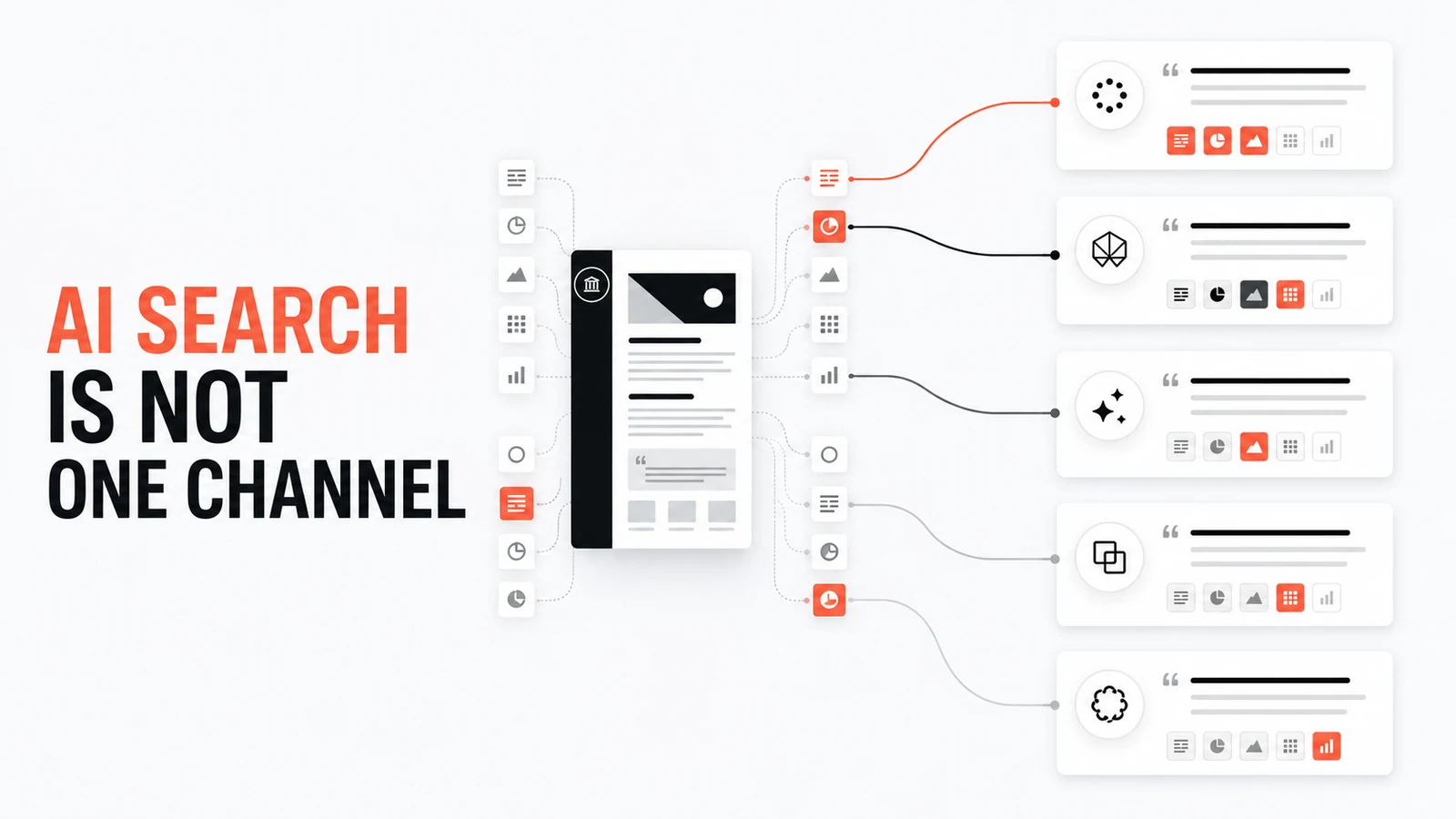
Buyers do not evaluate a business from its website alone. Search engines do not rely on one page alone. AI search systems may retrieve and cite information from across the web. Reviews, industry publications, directories, profiles, communities, competitor pages, product listings, expert bios, case studies, and original research can all become part of the evidence surrounding a brand.
That does not mean there is one universal AI authority score or a secret off-page formula that guarantees citations. There is not. Google says its core SEO practices remain relevant to AI features and that there are no special technical requirements for inclusion beyond normal search eligibility. OpenAI says public websites can appear in ChatGPT search and recommends allowing OAI-SearchBot if a publisher wants content to be discoverable and cited. Perplexity describes its product as a web-search system that synthesizes answers from cited sources. Those systems are not identical, and their outputs can vary.
The practical implication is more useful than the hype: build a clear, credible, consistent information ecosystem around your business rather than optimize for one platform or chase isolated mentions.
What Search & AI Authority means
Search & AI Authority is the strength and consistency of the evidence available about your brand across the places buyers and retrieval systems may encounter it. It is not a single ranking factor. Think of it as an operating framework for making your business easier to verify, understand, compare, and trust.
- A clear source of truth on your own website
- Relevant third-party validation
- Visible reputation and customer evidence
- Citation-worthy original information
- Consistent entity and business information
- Accurate representation across search and AI experiences
- A competitive footprint strong enough to survive comparison
1. Start with a source of truth you control
Off-page authority starts on-page. If your own website is vague, inconsistent, or thin, third-party signals have nothing stable to reinforce.
Your site should make the following facts easy to verify:
- Official company name and what the company does
- Core services, products, specialties, and markets served
- Who leads the company and why that person or team is credible
- Locations and service areas where relevant
- How customers work with you or buy from you
- Evidence you can support: reviews, case studies, examples, credentials, results, or other proof
- Contact details and clear next steps
- Policies or business details that reduce uncertainty for a buyer
Quick source-of-truth test
Open your homepage, About page, top service page, and strongest proof page. Without relying on what you already know about the business, ask:
- Do all four pages describe the business consistently?
- Could a stranger identify the primary service and buyer?
- Are names, titles, locations, credentials, and company facts consistent?
- Is there proof near the claims it is meant to support?
- Would an AI system have to infer important facts that you could simply state?
2. Map the third-party sites that validate your brand
A backlink is useful, but a link is not the whole story. A relevant third-party page can validate that your company exists in a category, associates you with a topic, confirms a credential, reviews a product, quotes an expert, lists a location, or documents a relationship.
The goal is not to collect mentions everywhere. The goal is to earn the right kinds of mentions in places that make sense for your market.
| Column | What to record |
|---|---|
| Domain or platform | The source and source type |
| Buyer value | Why it matters to the buyer |
| Evidence | Whether it mentions or links to your company |
| Accuracy | Whether the information is current and correct |
| Competitive context | Which competitors appear |
| Next action | A specific opportunity or correction |
Source categories to research
Build the map around the sources a real buyer may trust:
- Industry publications and trade media
- Professional associations and membership directories
- Relevant local or regional publications
- Niche directories buyers actually use
- Partner, vendor, customer, or ecosystem websites
- Podcast, webinar, conference, and event pages
- Review and comparison platforms
- Marketplaces or product databases where relevant
- Community discussions and forums that genuinely influence the buying journey
Avoid the old habit of treating every directory or guest-post opportunity as equal. Relevance and credibility matter more than volume.
3. Reverse-engineer competitor authority, not only competitor rankings
Competitor SEO analysis often stops at keywords and backlinks. That misses a more strategic question: why is the competitor easier for the market to verify?
Run these searches for two or three competitors. Replace the brackets with the actual brand name:
- "[competitor]" -site:competitor.com
- "[competitor]" review
- "[competitor]" interview
- "[competitor]" podcast
- "[competitor]" case study
- "[competitor]" association
- "[competitor]" award
- "[competitor]" alternatives
- "[competitor]" vs
- "[competitor]" founder OR CEO OR expert
For each useful result, record the domain and what kind of evidence it provides. After 20 to 30 results, patterns usually become more visible. Maybe the competitor is repeatedly quoted in industry media. Maybe it has stronger review coverage. Maybe its founder has more expert interviews. Maybe its original research is earning references. Maybe the market understands its category more clearly because dozens of third-party pages describe it consistently.
You are not looking for a list to copy. You are looking for the authority gap.
4. Build reputation signals buyers can actually inspect
Reviews and customer evidence sit at the intersection of search visibility and buyer trust. For local search specifically, Google says local results are primarily based on relevance, distance, and prominence, and identifies links and reviews as examples of information used in prominence. Google also encourages businesses to keep profiles complete and respond to reviews.
For non-local businesses, the exact mechanisms differ, but the buyer principle remains: claims become more persuasive when another party can validate them.
Reputation audit
Use a consistent review pass instead of looking only at your star rating:
- Search your company name plus reviews, complaints, and the relevant community for your market
- Review your Google Business Profile if local search matters
- Check the primary review platforms in your industry
- Compare review volume, recency, specificity, and response quality with three competitors
- Look for repeated themes: what customers consistently praise, question, or complain about
- Check whether the strongest evidence is visible on your own site near key decision points
Do not manufacture reputation. Do not create fake reviews, fake third-party sites, or synthetic consensus. Strong authority is evidence you can defend.
Free illustrated Field Guide
Want the working version of this framework?
Download the free Search & AI Authority Field Guide. The article explains the framework. The Field Guide gives you the worksheets, competitor research queries, AI visibility test matrix, Authority-Source Map, entity audit, prioritization framework, and 30/60/90-day action planner to run the process on your own business.
- Source-of-truth audit
- Competitor research queries
- AI visibility test matrix
- Authority-Source Map
- Entity audit
- 30/60/90-day action planner
5. Create information worth citing
One of the strongest ways to build an authority footprint is to publish information other people cannot get by summarizing the first page of Google.
Google emphasizes unique, valuable, non-commodity content in its guidance for generative AI features. Its people-first guidance asks whether content demonstrates first-hand expertise and leaves readers feeling they learned enough to achieve their goal.
- Original research or survey data
- Benchmarks from work you are legitimately able to aggregate
- A proprietary framework that explains a problem clearly
- Definitions based on real expertise
- Detailed how-to guides with original examples
- Calculators, diagnostic tools, templates, or checklists
- Case studies showing the problem, decision, intervention, and outcome
- Expert commentary on new developments in your field
- High-quality comparison or decision content that helps a buyer evaluate options
6. Test how AI systems represent the brand
AI visibility testing should be treated as observation, not a deterministic rank tracker. Different systems may use different sources, retrieval methods, models, and context. Even the same system can return different answers across sessions or prompts.
Use AI testing to identify patterns, inaccuracies, competitor presence, and source gaps. Do not turn one prompt into a sweeping conclusion.
| Platform | Prompt | Mentioned? | Description accurate? | Competitors | Sources / citations | Gap |
|---|---|---|---|---|---|---|
| ChatGPT | Not recorded | Not recorded | Not recorded | Not recorded | Not recorded | Not recorded |
| Gemini | Not recorded | Not recorded | Not recorded | Not recorded | Not recorded | Not recorded |
| Claude | Not recorded | Not recorded | Not recorded | Not recorded | Not recorded | Not recorded |
| Perplexity | Not recorded | Not recorded | Not recorded | Not recorded | Not recorded | Not recorded |
| Google AI experiences | Not recorded | Not recorded | Not recorded | Not recorded | Not recorded | Not recorded |
Run a repeatable five-question test
Use buyer-realistic prompts across the platforms that matter to your audience. For example:
- What companies are known for [category/problem]?
- Who are the best [category] providers for [specific buyer or use case]?
- What is [your company] known for?
- Compare [your company] with [competitor].
- Which providers would you consider for [specific buying problem], and why?
Repeat the same prompt set periodically and look for patterns. A useful question is not simply “Did we get mentioned?” It is “What evidence seems to be available about us, and where is it weak, inconsistent, or missing?”
7. Fix entity inconsistencies before chasing more mentions
A brand can create unnecessary ambiguity when its own information changes from site to site. This is especially obvious for local businesses, multi-location companies, renamed companies, professional practices, and founder-led firms.
Entity consistency check
Review these fields across the website, major profiles, and the relevant platforms:
- Official company name and common brand name
- Primary domain and canonical URLs
- Founder, executive, provider, or expert names and titles
- Address, phone, service area, and hours where relevant
- Product and service naming
- Company description and category language
- Social and professional profiles
- Major directory and marketplace profiles
- Accurate Organization, Person, Service, LocalBusiness, Product, Article, or other relevant structured data
Structured data helps machines interpret page information, but schema is not a substitute for authority. It should match visible page content. Treat it as clarification, not a shortcut.
8. Prioritize authority work by commercial value
The biggest mistake is turning this into another giant SEO checklist. Not every missing directory, citation, mention, or article deserves attention.
Score opportunities against four questions:
| Factor | Question |
|---|---|
| Buyer relevance | Would a real prospect use or trust this source? |
| Authority value | Would this source meaningfully validate expertise, legitimacy, or category relevance? |
| Effort | How difficult or expensive is the opportunity? |
| Commercial connection | Does it support a priority service, market, product, location, or buying decision? |
A highly relevant industry publication that influences buyers may be more valuable than 50 generic directories. A detailed case study may be more useful than ten generic guest posts. Fixing inaccurate information on a major profile may matter more than publishing another article.
A 30-day Search & AI Authority sprint
If you want to act on this without turning it into a six-month project, start here:
- Week 1: Verify your source-of-truth pages and fix obvious entity inconsistencies.
- Week 1: Run the competitor authority searches for three competitors and build a source map.
- Week 2: Audit review and reputation surfaces that matter to your market.
- Week 2: Run the five-question AI visibility baseline across relevant platforms.
- Week 3: Choose one authority gap worth fixing: proof, expert visibility, third-party validation, original research, local presence, or another evidence gap.
- Week 3: Build or improve one citation-worthy asset.
- Week 4: Pursue a small number of high-relevance distribution or third-party opportunities.
- Week 4: Document the baseline and set a monthly or quarterly review cadence.
The goal is not to do off-page SEO. The goal is to make the business easier to discover, verify, understand, and trust wherever serious buyers research it.
Final takeaway
Search & AI authority is not about creating the illusion that everyone on the internet talks about your brand. It is about building a credible body of evidence that makes your company easier to understand and verify.
Start with the facts you control. Strengthen the third-party sources that matter. Publish information worth referencing. Monitor how the market and AI systems represent you. Fix inconsistencies. Then prioritize the gaps that have a real connection to how buyers find, trust, and choose your business.
Free illustrated Field Guide
Want the working version of this framework?
Download the free Search & AI Authority Field Guide. The article explains the framework. The Field Guide gives you the worksheets, competitor research queries, AI visibility test matrix, Authority-Source Map, entity audit, prioritization framework, and 30/60/90-day action planner to run the process on your own business.
- Source-of-truth audit
- Competitor research queries
- AI visibility test matrix
- Authority-Source Map
- Entity audit
- 30/60/90-day action planner
Company-specific diagnosis
Found several gaps but not sure which ones matter most?
The Buyer Discovery Audit is OutsourceSy’s consultant-led diagnostic for businesses that need company-specific analysis and prioritization across discovery, understanding, trust, choice, response, and conversion.
Learn About the Buyer Discovery AuditSources
- Google Search Central: AI features and your website
- Google Search Central: Optimizing your website for generative AI features
- Google Search Central: Creating helpful, reliable, people-first content
- Google Business Profile Help: Tips to improve local ranking
- OpenAI: Publishers and Developers FAQ
- OpenAI: Searching the web with ChatGPT
- Perplexity: What is Perplexity?
- Perplexity: Understanding source labels