Many AI visibility audits are prompt reports with a more ambitious name. They run a list of questions, capture which brands appeared and convert the result into a score. That can establish a baseline, but it does not explain what the company should improve.
A serious audit connects the output to the evidence. It asks why a business may be absent, misrepresented or weakly supported, which parts of the problem are observable and which remain hypotheses. It also follows the buyer beyond the answer into the website, reviews and decision path.
The value is not the number of prompts tested. It is the quality of the diagnosis and the priority of the next action.
Begin with business context and buyer questions
A random prompt list produces random findings. The audit should begin with the organization’s priority services, ideal buyers, markets, competitors and commercial goals. A question matters because it can affect whether a qualified buyer discovers or evaluates the business, not because it produces an interesting screenshot.
Map questions across the research journey. Include branded accuracy questions, category discovery, problem-aware research, approach comparisons, local or service-area needs, risk concerns and provider evaluation. The list should be small enough to repeat and broad enough to expose meaningful differences.
- Which services or products have the greatest business value?
- What does the buyer need to understand before comparing providers?
- Which competitors enter the consideration set?
- Which locations, industries or use cases materially change the answer?
- Which questions are informational, and which are close to a buying decision?
Measure each platform as a separate surface
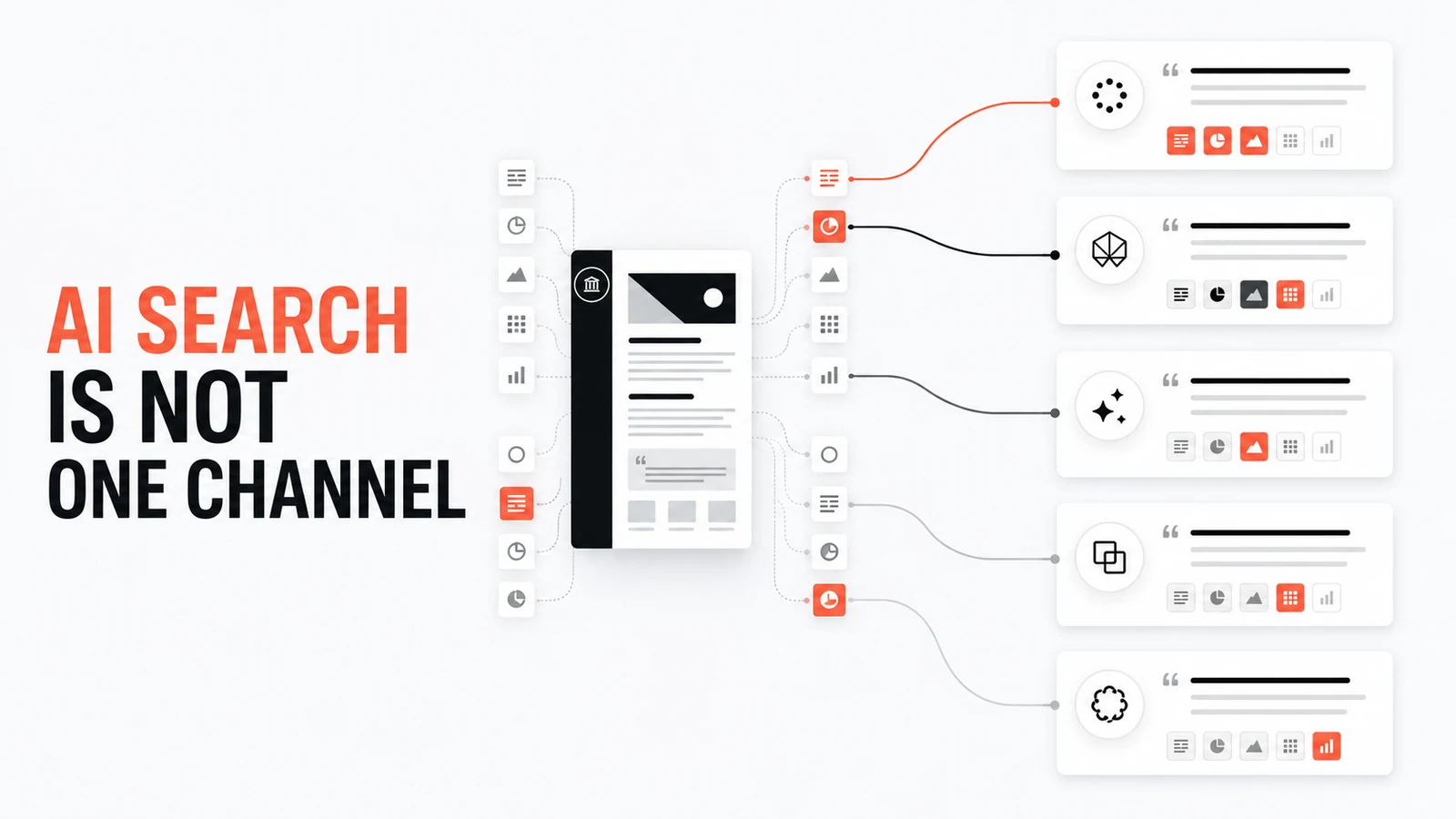
There is no universal AI result. ChatGPT, Claude, Gemini, Perplexity, Google AI Overviews and Google AI Mode can use different product features, retrieval systems, sources and response formats. An audit should not combine them into one score that hides the differences.
For each question, record whether the business is cited, mentioned, recommended or absent. Note how it is described, whether the description is accurate, which competitors appear and which sources are visible. Repeat important tests to identify variability.
The audit should also document the limits of the observation. A product without current web access is not testing the same thing as a search-enabled experience. A location-specific answer may change when context changes. Those conditions belong in the report.
Inspect the sources and evidence behind the answer
A brand-level result is only the symptom. The useful work begins when the audit examines the pages and sources that support the answer. A competitor may be cited because of a detailed service page, an independent comparison, a directory profile, a review pattern or an article that directly answers the question.
Source analysis should distinguish first-party evidence from third-party corroboration. The company website can explain services, methods and expertise. External sources can confirm reputation, credentials, category association and real-world experience. Both can be incomplete or inconsistent.
Questions for every recurring source
The audit does not need to reverse-engineer a platform’s private ranking system. It does need to evaluate the observable evidence with discipline.
- What question does this source answer well?
- Is the information current and specific?
- Does it identify the organization and service clearly?
- What proof or corroboration does it contain?
- Can the company create a stronger first-party source or earn legitimate external evidence?
Review entity and business clarity
A business can have strong content and still be difficult to resolve as a coherent entity. The audit should examine whether the organization, experts, services, locations and brand names are connected consistently across the website and relevant external sources.
This includes About pages, expert profiles, service descriptions, contact information, directory listings and structured data. Markup can reinforce accurate relationships, but it should never introduce claims that are not visible or supportable on the page.
Include the traditional search and technical foundation
An AI audit that ignores technical SEO can miss the reason useful evidence is difficult to retrieve. The review should cover crawl controls, status codes, canonicalization, redirects, sitemaps, rendering, internal links and the indexability of priority pages.
Traditional search results also shape AI-era discovery. Buyers still use Google, and AI features may surface links from the web. Search visibility, page quality and AI representation should be analyzed as connected parts of the same system.
- Priority-page indexation and canonical consistency
- Internal links to source-of-truth service and expert pages
- Content rendered in crawlable HTML
- Duplicate or conflicting business information
- Structured data validation and visible-content alignment
- Mobile access, performance and usability constraints
Evaluate trust, reputation and corroboration
Recommendation questions are partly trust questions. The audit should examine reviews, expert credentials, case evidence, relevant affiliations, public contributions and third-party mentions. It should also identify where the company’s claims are unsupported or where competitors present stronger evidence.
Review analysis should look beyond the average rating. Specificity, recency, platform relevance, response quality and recurring themes can reveal what buyers believe the organization does well and where expectations break.
Follow the buyer into the website
Visibility has limited value if the cited or linked page creates confusion. The audit should assess whether a buyer can understand the offer, determine fit, verify expertise and take an appropriate next step.
This is where a narrow AI prompt report becomes a business diagnostic. It connects platform behavior to the parts of the journey the company can control: service clarity, proof, navigation, calls to action, forms and the transition from research to contact.
Prioritize findings by business consequence
A 100-item issue list is not a strategy. Findings should be grouped by root cause and sequenced according to business importance, confidence, effort and dependencies. Immediate accuracy or access problems usually come before speculative platform tactics.
- Correct material factual errors and broken access paths.
- Fix high-value service and source-of-truth page gaps.
- Resolve entity and business-information inconsistencies.
- Strengthen proof, reviews and third-party corroboration.
- Improve buyer questions, comparisons and decision content.
- Establish a repeatable platform-by-platform measurement baseline.
Where the Buyer Discovery Audit goes further
An AI search audit can be useful when the business problem is narrowly defined. The OutsourceSy Buyer Discovery Audit examines the broader research journey across Google, AI platforms, websites, reviews, competitors, trust signals and conversion paths.
The broader scope matters when the company is not merely asking whether it appears in an answer. It matters when leadership needs to understand why qualified buyers struggle to find, understand, trust, compare or choose the business — and what should change first.