A prospective customer no longer has to search for a service, open ten tabs, compare every provider, and build a shortlist alone.
They can ask an AI assistant a detailed question instead:
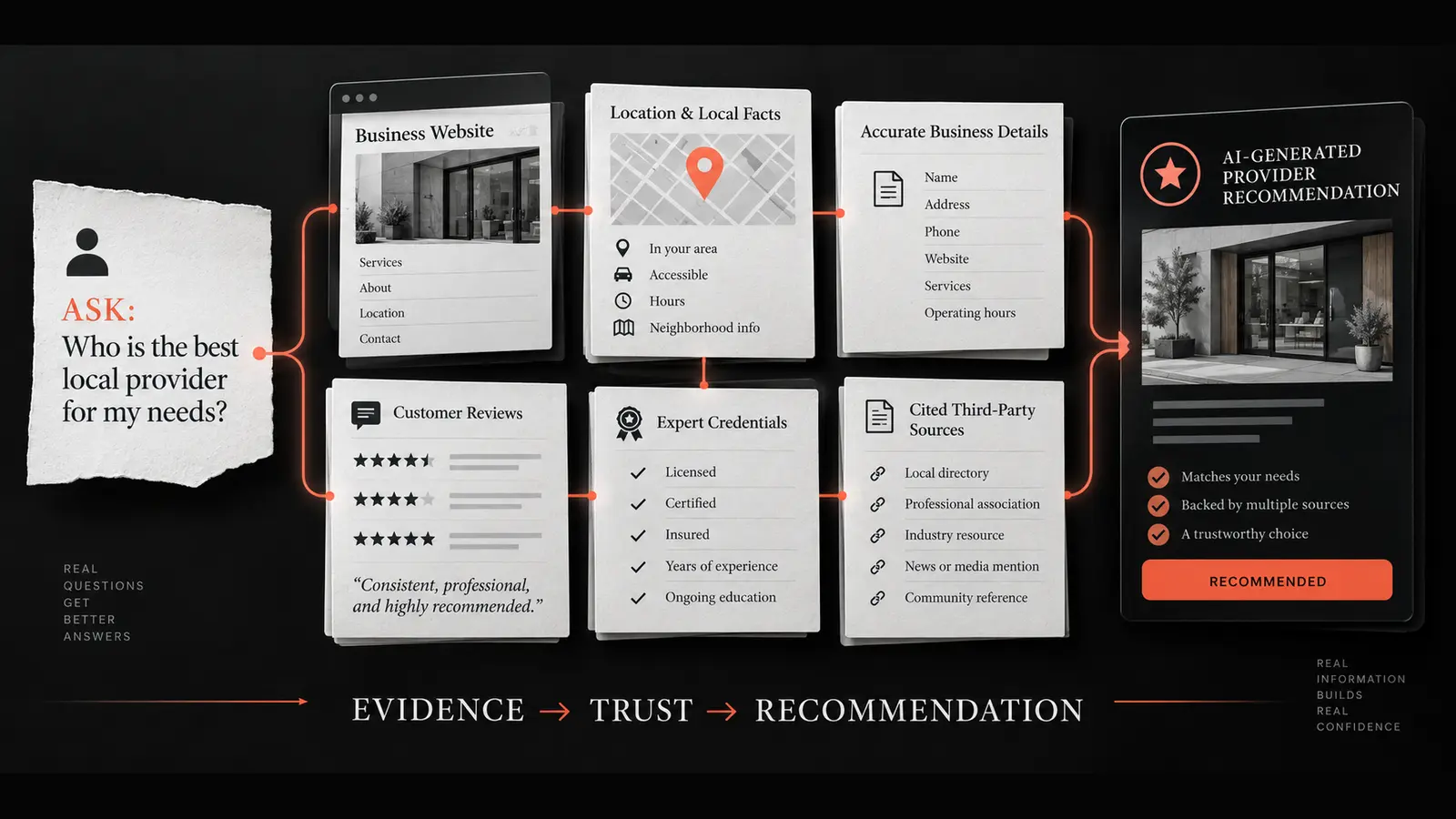
What is the best local provider for someone who wants individual attention, specialized expertise, and a convenient location?
That question is more valuable than a broad keyword. It contains a service, a location, a need, a preference, and a reason for choosing one provider over another.
It also exposes a growing problem for local businesses.
Your business may be legitimate, experienced, and highly regarded. But if search engines and AI systems cannot clearly determine what you do, where you operate, who you serve, and why you are credible, you may never become part of the answer.
The goal is no longer simply to rank for a keyword. The goal is to be easy to find, trust, and choose when a potential customer is actively comparing options.
AI recommendation visibility starts with evidence
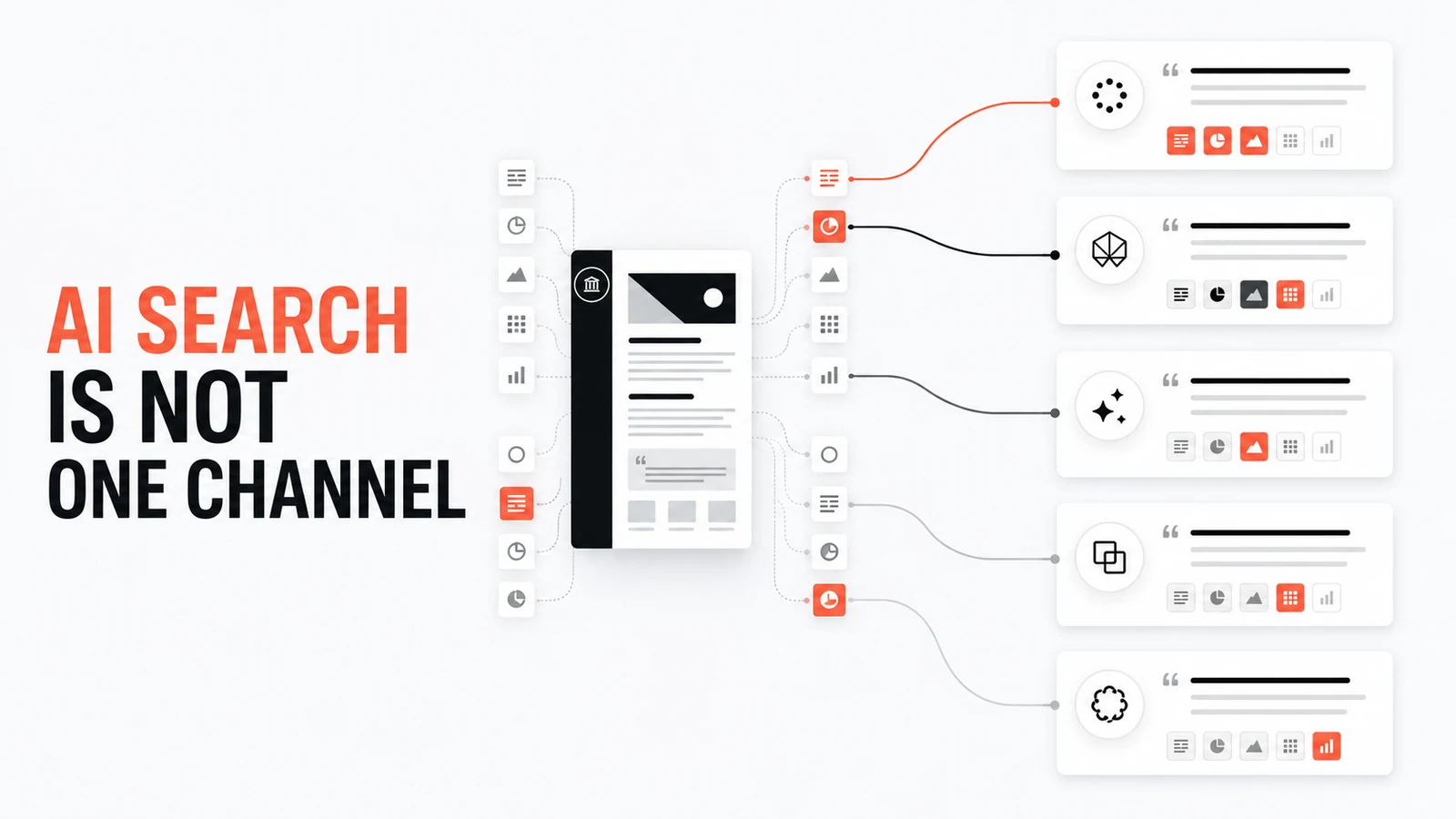
There is no button that makes ChatGPT, Google, Gemini, Perplexity, or Copilot recommend a business.
AI systems assemble answers from available information. Depending on the platform and question, that information may include business websites, search indexes, maps, directories, reviews, articles, professional profiles, community sources, and other third-party references.
Google says its generative AI search features remain grounded in its core search systems. Its current guidance emphasizes crawlable pages, sound technical SEO, useful original content, and accurate business information rather than special GEO tricks. Google also explains that local results are primarily influenced by relevance, distance, and prominence. (Google Search Central, Google Business Profile Help)
ChatGPT Search can connect users with web sources and provide citations. OpenAI also allows publishers to control access for its search crawler and identify ChatGPT referral traffic in analytics. (OpenAI publisher guidance)
This means a local business needs more than a technically functional website. It needs a consistent body of evidence that supports its place in a recommendation.
The seven layers of a recommendable local business
1. Clear entity information
Search and AI systems should not have to infer the fundamentals of your business.
Your website and external profiles should consistently communicate:
- Your official business name
- Your location and service area
- Your primary services
- The customers you serve
- Your specialties and differentiators
- Your hours, contact information, and booking process
- Your professional credentials and relevant affiliations
If your homepage describes your company one way, your Google Business Profile uses different categories, and local directories contain outdated contact information, the business becomes harder to interpret confidently.
Clarity is particularly important for businesses that combine several services or use unfamiliar language to describe their approach.
2. Pages that match how customers make decisions
A single services page rarely answers every question a serious buyer asks.
Local customers search at different stages:
- Problem recognition: What kind of service do I need?
- Service research: How does this service work?
- Suitability: Is it appropriate for someone like me?
- Comparison: How is this different from another option?
- Local evaluation: Is there a qualified provider near me?
- Trust: What experience, credentials, and proof support this provider?
- Action: What happens if I call, book, or submit a form?
Your content architecture should support those decisions. That may require dedicated service pages, audience pages, comparison content, practical FAQs, location information, and clear next steps.
The objective is not to manufacture a page for every imaginable keyword. It is to answer the meaningful questions customers already use to decide.
3. A complete local search foundation
For a location-dependent business, AI visibility cannot be separated from local search visibility.
The foundation normally includes:
- A complete and accurate Google Business Profile
- Appropriate primary and secondary business categories
- Consistent name, address, and phone information
- Accurate hours and appointment details
- Relevant services and business descriptions
- Current photographs and other useful media
- A review-acquisition and response process
- Accurate listings in reputable local and industry directories
- A website that clearly supports the location and service claims in the profile
Distance will always affect some local results. A business cannot optimize its way around the customer's physical location. But it can improve relevance and prominence by making its qualifications, services, and community presence easier to verify.
4. Demonstrable expertise and trust
Claiming expertise is not the same as demonstrating it.
A credible local provider should make its expertise visible through appropriate evidence, such as:
- Detailed team biographies
- Licenses, certifications, and professional training
- Named authors and expert reviewers
- Firsthand explanations of services and processes
- Original photographs and videos
- Transparent policies and expectations
- Accurate customer reviews
- Professional memberships
- Community involvement
- Partnerships with related providers or organizations
- Local media coverage and independent references
This matters most in healthcare, wellness, legal, financial, education, home services, and other categories where customers face meaningful risk when choosing incorrectly.
The strongest content usually comes from genuine experience. Generic articles that repeat information already available everywhere provide little reason for a search engine, AI system, or customer to prefer your business.
5. Structured and technically accessible information
Structured data can provide explicit clues about a business and its content. For eligible businesses, LocalBusiness and Organization markup may clarify details such as the business type, address, telephone number, hours, and other properties. Google recommends validating structured data and ensuring the underlying pages remain crawlable and indexable. (Google LocalBusiness documentation)
But schema is supporting evidence, not a magic recommendation switch.
Technical checks should also cover:
- Indexability
- Robots directives
- Canonical tags
- XML sitemaps
- Mobile usability
- Page performance
- Internal linking
- Status codes and redirect chains
- Duplicate or conflicting location pages
- Whether important information is present in accessible page content
- Whether relevant search crawlers are unintentionally blocked
A technically confusing site can weaken otherwise excellent content.
6. Independent corroboration
A business becomes easier to trust when credible external sources support what it says about itself.
Useful corroboration may come from:
- Chambers of commerce
- Professional associations
- Local news coverage
- Community organizations
- Event listings
- Healthcare or professional directories
- Partner organizations
- Educational institutions
- Interviews and expert contributions
- Genuine customer discussions and reviews
The objective is not to scatter the company name across low-quality directories or purchase artificial mentions. It is to build a real footprint within the communities and professional ecosystems the business already serves.
7. A buyer journey that validates the recommendation
Visibility is wasted if the website creates doubt after the customer arrives.
A person who follows an AI recommendation should immediately understand:
- Why the provider may fit their needs
- What makes the service different
- Who will deliver the service
- Where and how it is available
- What the experience will involve
- What the next step is
- Whether the business appears safe, current, and credible
Common conversion problems include generic calls to action, unclear service boundaries, hidden locations, weak team information, excessive form requirements, confusing booking systems, and pages that describe features without helping the customer make a decision.
AI visibility and conversion optimization belong in the same strategy. A business has not won because it appeared in an answer. It wins when the right customer understands the recommendation and confidently takes the next step.
How to improve the chance of appearing in a specific AI recommendation
Consider a prompt such as:
What is the best Pilates studio in Redondo Beach for someone who wants more individual attention and athletic programming?
No ethical consultant can guarantee that a specific business will be named. What the business can do is strengthen the evidence an answer system could use.
Step 1: Establish the baseline
Test a controlled group of prompts across multiple platforms. Vary the wording, customer need, location, and stage of the decision.
Document:
- Which businesses appear
- Which sources are cited
- Which attributes the answer emphasizes
- Whether the target business appears accurately
- Whether important services or differentiators are missing
- Whether results change when the location or customer need changes
This is not a one-time ranking check. AI answers can vary, and platforms change. The purpose is to identify patterns and evidence gaps.
Step 2: Audit the cited sources
If competitors are consistently recommended, study the evidence supporting them.
Are AI answers relying on Google Maps, local publications, review platforms, service pages, professional profiles, community directories, or comparison content? Are competitors described more clearly? Do they have stronger independent validation?
The answer determines whether the first priority is the website, local profiles, reviews, content, technical repair, or authority building.
Step 3: Clarify the differentiator
The business must clearly substantiate the qualities included in the prompt.
In the example above, the website should explain what “individual attention” means in practice. Is it limited class size, instructor-to-client ratio, private onboarding, personalized modifications, or something else?
It should also demonstrate “athletic programming” with specific program information, instructor qualifications, appropriate examples, and supporting proof.
Vague marketing language will not provide the same evidentiary value.
Step 4: Build the missing decision content
Create or improve the pages that help customers evaluate fit. Depending on the business, that could include:
- A detailed service or class page
- A first-visit guide
- A comparison between two commonly confused options
- An instructor or provider page
- An audience-specific page
- A location and service-area page
- A safety, eligibility, or expectations FAQ
- A community-resource page based on real local expertise
Every page should have a useful role in the customer journey. Publishing volume is not the goal.
Step 5: Strengthen local and professional authority
Develop relationships and references that make sense beyond SEO.
For a wellness business, that might include responsible partnerships with physical therapists, sports organizations, trainers, community groups, or local events. For a professional service firm, it might include associations, educational programs, expert commentary, or referral partners.
Real-world authority is often the most defensible digital authority.
Step 6: Retest and connect visibility to outcomes
Retest the prompt set after meaningful changes have been discovered, indexed, and reflected across external sources.
Then connect visibility to business results where measurement permits:
- Qualified organic inquiries
- Calls and bookings from local search
- Google Business Profile actions
- Non-branded search growth
- Engagement with service and location pages
- ChatGPT and other identifiable referral traffic
- Assisted conversions
- Accuracy and frequency of AI citations or mentions
AI visibility should not be reduced to a single score. The commercial question is whether more qualified customers are finding, trusting, and choosing the business.
A practical 90-day roadmap
Days 1–15: Diagnose
- Establish search, local, AI, and conversion baselines
- Audit technical accessibility and indexation
- Review Google Business Profile and key listings
- Map customer questions to existing pages
- Identify conflicting facts, missing proof, and conversion friction
Days 16–45: Fix the foundation
- Correct critical technical issues
- Align business information across priority sources
- Improve core service, audience, and location pages
- Add appropriate structured data
- Strengthen provider biographies, credentials, and trust information
- Clarify calls to action and booking expectations
Days 46–75: Build decision support and authority
- Publish the highest-priority comparison, FAQ, or service content
- Establish a responsible review process
- Correct high-value directory profiles
- Pursue relevant community and professional references
- Connect related pages through stronger internal linking
Days 76–90: Measure and prioritize
- Retest the original prompt set
- Review organic, local, AI-referral, and conversion indicators
- Identify what changed and what did not
- Separate continuing work from low-value activity
- Build the next implementation roadmap around business impact
What not to do
Businesses should be skeptical of anyone promising to manipulate AI recommendations through shortcuts.
Avoid strategies built around:
- Hundreds of generic AI-generated articles
- Fake reviews or manufactured community discussions
- Low-quality directory submissions
- Purchased links with no audience relevance
- Unsupported health, performance, or professional claims
- Schema presented as a guaranteed ranking tactic
- Reporting that celebrates impressions while ignoring inquiries and revenue
- Guaranteed placement in ChatGPT or another answer engine
Google explicitly says that useful, original, people-first content and established SEO practices remain more important than supposed AEO or GEO hacks. It also warns that scaled AI-generated pages without added value may violate its spam policies. (Google guidance on AI-generated content)
The real question is not “Are we doing GEO?”
The better questions are:
- Can search engines and AI systems accurately understand our business?
- Do credible sources support what we claim?
- Have we answered the questions customers use to compare providers?
- Does our website help the right buyer confidently take action?
- Can we connect improved visibility to inquiries, bookings, or revenue?
That is the work behind becoming recommendable.
It is not a separate layer of tricks placed on top of SEO. It is the coordination of technical clarity, useful content, local relevance, independent trust, and buyer-journey design.
Find the breakpoints before investing in more content
OutsourceSy helps healthcare, wellness, professional-service, education, technology, and other research-heavy organizations identify what prevents buyers from finding, trusting, and choosing them.
The Buyer Discovery Audit examines search visibility, AI-answer presence, website structure, authority signals, and conversion friction. It produces a prioritized 90-day roadmap focused on the problems most likely to affect qualified demand.
Explore the Buyer Discovery Audit or request a discovery review.
Practical questions
Frequently Asked Questions
Can a business pay to be recommended by ChatGPT?
Businesses should not treat organic AI recommendations as paid placements. Platforms may offer separate advertising or commerce products, but those are different from being selected as an organic answer. No consultant can ethically guarantee that ChatGPT or another AI system will recommend a specific provider.
Does schema markup make a business appear in AI answers?
Schema can help search engines interpret explicit business and page information, and it may support eligibility for certain search features. It does not guarantee rankings, citations, or recommendations. It works best when it accurately reflects visible, useful page content.
Is traditional SEO still important for AI visibility?
Yes. Google states that its established search systems and SEO best practices remain relevant to its generative AI features. Crawlability, indexation, useful content, internal linking, authority, and accurate business information still matter.
Do reviews influence AI recommendations?
Reviews can contribute useful evidence about prominence, customer experience, and local relevance. Their influence varies by platform and query. Review quality, recency, authenticity, specificity, and consistency matter more than chasing volume through improper incentives.
How long does it take to improve AI visibility?
There is no universal timeline. Technical corrections may be discovered relatively quickly, while authority building, new content, review development, and third-party recognition take longer. Changes must also be crawled, indexed, and incorporated into the sources an AI system uses.
How should a local business measure AI visibility?
Use controlled prompt testing, citation analysis, identifiable AI referral traffic, Search Console data, Google Business Profile performance, non-branded organic discovery, qualified inquiries, bookings, and assisted conversions. No single visibility score provides the full picture.