The fastest way to make a bad process more expensive is to automate it.
A company rolls out ChatGPT. Marketing buys an AI content tool. Sales gets an AI email assistant. Customer service launches a chatbot. Someone connects a few workflows with automation. Six months later, leadership can point to more tools, more output and more activity, but it is much harder to answer a basic question: Is the business actually working better?
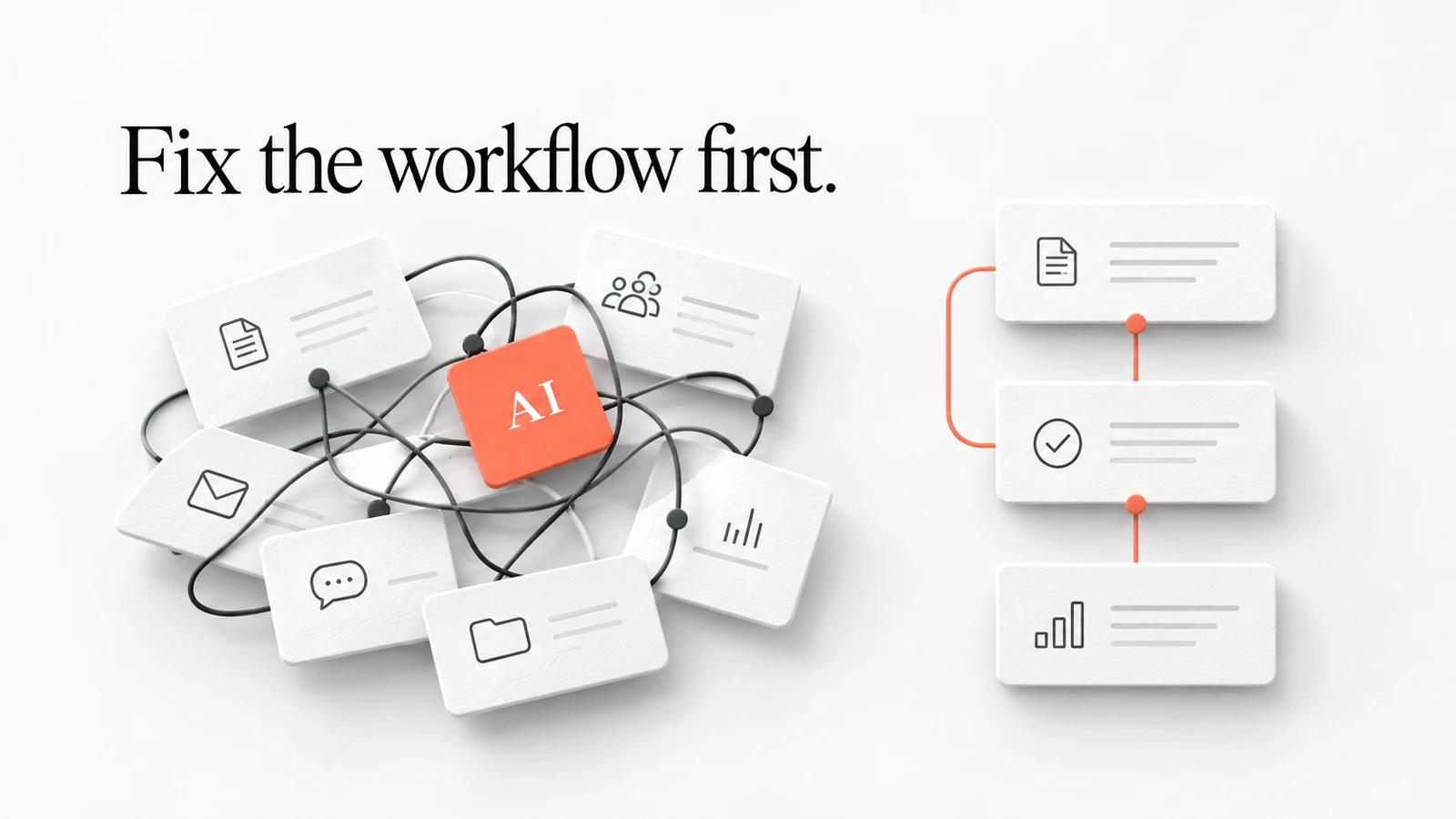
That is where a lot of AI adoption is getting stuck. Businesses are adding AI one task at a time without redesigning the work around it. The old approvals remain. The same handoffs remain. The same messy data remains. The same unclear ownership remains. AI gets dropped on top and is expected to create efficiency by itself.
It usually does not.
The real opportunity is not to ask, "Where can we add AI?" It is to ask, "Where is work unnecessarily slow, repetitive, inconsistent or expensive, and what is the simplest way to improve it?" Sometimes the answer will be AI. Sometimes it will be automation. Sometimes it will be software the company already owns. Sometimes it will be deleting three steps nobody needed in the first place.
That distinction matters because access to AI is becoming common. Better operating systems are not.
Using AI is not the same as becoming an AI-enabled business
There is a difference between employees using AI and a company designing work so AI can improve outcomes.
In the first case, people experiment. They draft emails faster, summarize documents, generate ideas, create images or ask a model to analyze information. Those are useful productivity gains. I use AI that way too.
But from a leadership perspective, the bigger opportunity starts when you look at the workflow itself. How does a lead move from inquiry to response? How does research become a decision? How does a customer question get answered? How does marketing data become something leadership can act on? Where do employees repeatedly copy information from one system into another? Where does work wait for someone who should never have been in the loop?
That is where AI stops being a collection of clever tools and starts becoming part of how the business operates.
A better starting question
Do not start with: “What can AI do for us?” Start with: “Where is the business losing time, money, consistency or customer momentum?”
The workflow is usually the real problem
Take lead response as an example. A business may decide it needs an AI agent because inquiries are sitting unanswered for too long.
The tempting solution is to install a tool that replies instantly. But before doing that, I would want to understand the system underneath the delay. Where do leads arrive? Who owns them? How are they qualified? Which inquiries can receive a standard response? Which ones need judgment? What information is required before booking? Where is the conversation recorded? What happens when the first person does not respond?
If nobody can explain that process clearly, an AI agent will not fix the underlying problem. It may simply respond faster inside a process that is still confused.
This is why I think companies should treat AI adoption as an operating-design problem first and a technology problem second. The quality of the workflow sets the ceiling for the quality of the automation.
Automation can make a weak process fail faster
Efficiency is powerful, but efficiency applied to the wrong thing can create a bigger problem. A manual mistake might happen ten times a week. Once automated, the same mistake can happen hundreds or thousands of times before someone notices.
What this looks like in practice
| Situation | Inefficient AI move | Better decision |
|---|---|---|
| Lead qualification | Let AI score every lead using unclear criteria. | Define what a qualified lead means first, then automate the repeatable parts. |
| Content production | Generate 50 articles because AI makes content cheap. | Identify the buyer questions and content gaps that matter, then use AI to accelerate research and production. |
| Customer support | Launch a chatbot before defining answer boundaries or escalation. | Build a trusted knowledge source, define what can be answered safely, and route exceptions to a human. |
| CRM workflows | Automate a CRM that already contains duplicate fields and inconsistent stages. | Clean the process and data model before automating movement through the system. |
| Reporting | Ask AI to summarize every metric available. | Decide which measures change decisions, then automate collection and interpretation around those measures. |
The point is not that AI is risky or overhyped. The point is that AI amplifies the system it is placed inside. Good systems become more capable. Bad systems can become more chaotic.
AI should remove work, not become another layer of work
One of the easiest ways to evaluate an AI initiative is to look at what it adds to the organization.
If adoption creates another dashboard, another inbox, another approval step, another subscription, another place to copy data, another prompt library nobody maintains and another system employees have to remember, the company may have added technology without actually reducing friction.
A useful implementation should make something materially better. Faster. Simpler. More consistent. Less expensive. Easier to measure. Easier to scale. Preferably more than one of those.
If none of those changes can be observed, I would question whether the implementation solved a meaningful business problem at all.
A five-step framework for deciding where AI belongs
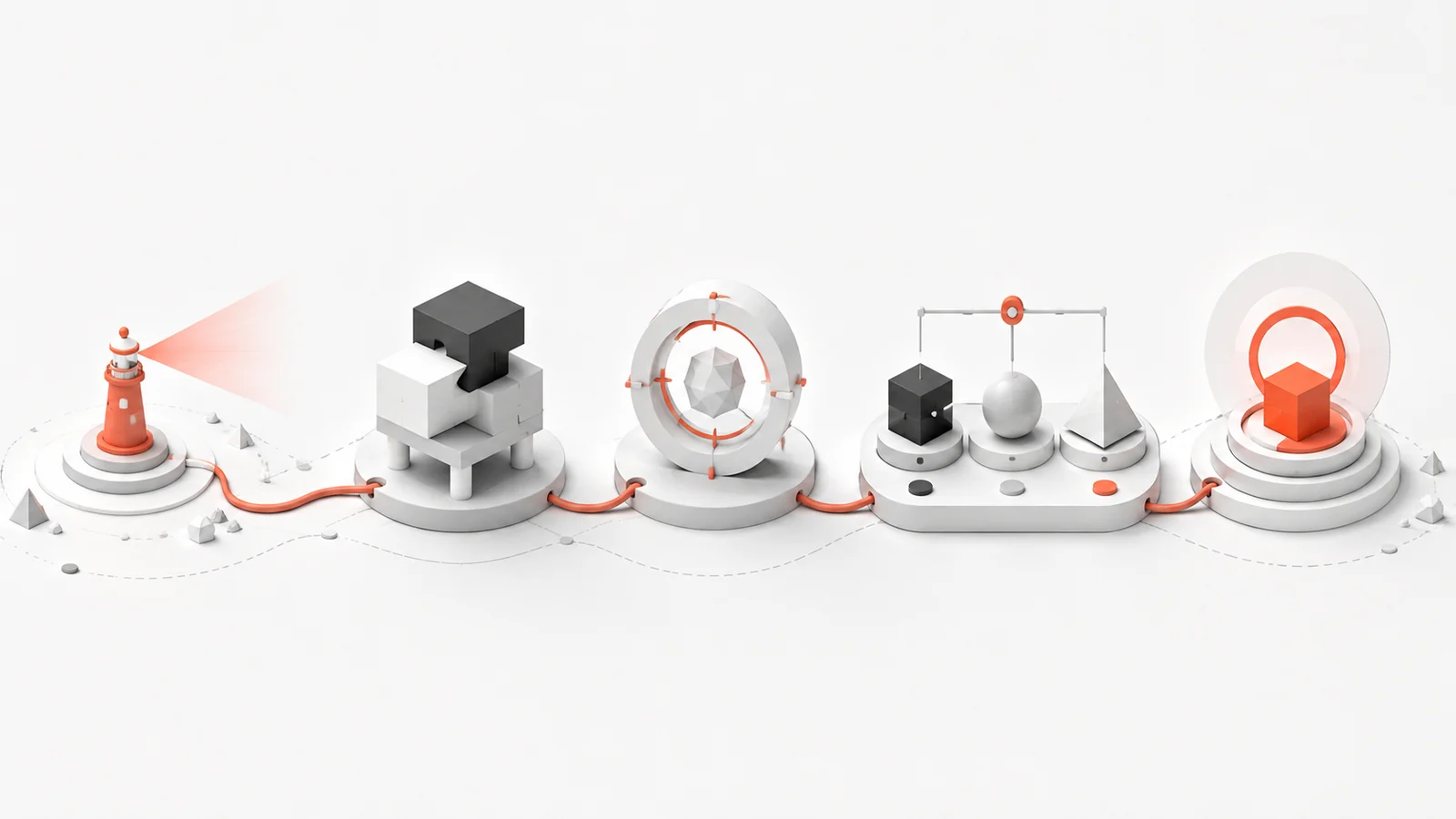
The framework I use is intentionally simple: Diagnose, Simplify, Implement, Adopt, Measure. The order matters. Skipping the first two steps is how companies end up automating work that should have been redesigned or removed.
Diagnose → Simplify → Implement → Adopt → Measure
1. Diagnose the business problem
Start with the outcome, not the technology.
Look for work that is slow, repetitive, inconsistent, difficult to measure or unnecessarily expensive. Pay attention to moments where customers wait, employees re-enter the same information, teams hand work back and forth, research gets repeated, reporting takes days or follow-up depends on someone remembering to do it.
The goal is not to create a giant list of things AI could theoretically do. It is to identify a small number of constraints that are commercially meaningful.
- Repetitive research or synthesis that consumes meaningful staff time
- Slow lead response or inconsistent follow-up
- Manual reporting that delays decisions
- Repeated customer questions with predictable answers
- Data entry or handoffs between systems
- Qualification, routing or scheduling that follows clear rules
2. Simplify the process before you automate it
This is the step most businesses rush past.
Ask a slightly uncomfortable question: If we were designing this workflow today, would we build it this way?
Remove unnecessary approvals. Consolidate duplicate fields. Clarify who owns the next action. Eliminate reports nobody uses. Reduce the number of systems involved. Decide what information is actually required. Standardize the common path and document the exceptions.
Sometimes the best AI strategy is deleting work. That is not as exciting as launching an agent, but it is often more valuable.
3. Decide what a human, automation and AI should each do
I would not frame this as "human versus AI." Most useful business systems will combine people, rules-based automation, software and AI. The question is which part belongs where.
| Type of work | Typical fit |
|---|---|
| High-volume, rules-based routing | Traditional automation or software |
| Research, synthesis and first drafts | AI-assisted workflow |
| Pattern recognition across large amounts of information | AI-assisted analysis with review |
| Sensitive exceptions and high-stakes decisions | Human judgment |
| High-value customer conversations | Human-led, AI-supported |
| Simple repetitive administrative work | Automation first, AI only if needed |
A CEO should care less about whether a process is technically "AI-powered" and more about whether it is reliable, economical and better for the customer and the team.
4. Implement AI only where it earns its place
Once the workflow is clear, then choose the technology.
This is where tool neutrality matters. A large language model may be the right solution. A CRM automation may be better. A simple form rule may be enough. The company may already own a feature that solves the problem. A custom build may be justified for a high-value workflow, but custom should not be the default simply because it sounds more advanced.
The simplest reliable solution usually wins because complexity has a carrying cost. Someone has to maintain the prompts, permissions, integrations, knowledge sources, exceptions and quality controls after launch.
5. Measure the business outcome
Launching the system is not the result.
Measure what changed after implementation. Did response time fall? Did fewer inquiries get lost? Did reporting take less time? Did follow-up happen more consistently? Did the team spend fewer hours on repetitive research? Did customers reach the right person faster? Did the workflow reduce errors?
Without a baseline and a meaningful outcome, it is easy to confuse activity with improvement.
CEO test
If leadership cannot explain what business metric or operating condition should improve, the AI initiative probably is not ready to be funded.
Four examples of smarter AI adoption
Marketing: from content volume to buyer usefulness
Weak approach: Ask AI to produce dozens of articles because content is now cheap.
Better approach: Identify the questions buyers actually ask, where the company lacks useful answers, which topics influence trust and choice, and what deserves original expertise. Use AI to accelerate research, outlines, first drafts, repurposing and quality checks. Keep human judgment around positioning, evidence and what is worth publishing.
The goal is not more words. The goal is a stronger research and decision journey for the buyer.
Sales: from mass personalization to better prioritization
Weak approach: Use AI to generate thousands of personalized cold emails.
Better approach: Define the signals that make a prospect worth attention. Use AI to help research observable triggers, summarize context and prepare a useful point of view. Keep humans responsible for deciding who deserves outreach and how to handle serious conversations.
AI can increase the speed of prospect research. It should not lower the standard for relevance.
Customer inquiries: from chatbot-first to workflow-first
Weak approach: Put a chatbot on the website because competitors have one.
Better approach: Review why customers contact the company, which questions have stable answers, what information is needed to route someone correctly, when a person should take over, and what happens after the conversation. Then decide whether AI chat, a structured form, scheduling automation or a human response is the best solution.
The customer does not care whether the system is impressive. They care whether it helps them get what they need.
Reporting: from automated summaries to better decisions
Weak approach: Feed every dashboard into AI and ask for weekly summaries.
Better approach: Decide which numbers leadership actually uses to make decisions. Automate the collection of those measures, then use AI to flag material changes, summarize likely explanations and identify what deserves investigation.
A prettier summary of irrelevant data is still irrelevant data.
The real competitive advantage will not be access to AI
Most companies will have access to increasingly capable models. Employees will have copilots. Software platforms will continue adding AI features. Many tasks that feel novel today will become standard features tomorrow.
That means access itself will not be much of a moat.
The advantage will come from what sits around the model: proprietary knowledge, clean data, clear workflows, good judgment, customer understanding, strong processes, useful standards and the ability to redesign how work gets done.
Two companies can use the same AI model and get very different results because one has a disciplined operating system around it and the other does not.
That is the part leaders should be paying attention to now.
Before you buy another AI tool, answer these questions
- What specific business problem are we trying to solve?
- What does the current workflow actually look like from start to finish?
- Which steps could be removed before anything is automated?
- Where is human judgment necessary?
- Which parts follow clear enough rules to automate?
- Does AI materially improve the solution, or would simpler automation work?
- Who owns the system after launch?
- What happens when the system is uncertain or wrong?
- What baseline will we compare against?
- What business outcome should improve if this works?
If a team cannot answer those questions, I would not rush to implementation. The organization probably needs to understand the process first.
The better AI strategy is usually the simpler one
I do not think businesses need less ambition around AI. I think they need more discipline around where it is applied.
The companies that get the most value from AI will not be the ones with the longest list of tools. They will be the ones that know where work is breaking down, remove what should not exist, automate what is predictable, use AI where it adds real capability and keep human judgment where it matters.
So before adding another agent, copilot or automation, map the workflow.
You may discover that AI is exactly what the business needs. You may also discover that the highest-value decision is much simpler.
Either way, that is a better place to start than automating the mess.
Practical questions
Frequently Asked Questions
How should a business decide where to use AI?
Start with a measurable business or workflow problem, map the current process, remove unnecessary steps, then decide whether AI is better than simpler automation or existing software. AI should solve a defined problem, not become the reason for creating a new project.
What business processes are good candidates for AI?
Strong candidates often involve repetitive research, synthesis, drafting, classification, customer questions, qualification support, reporting or pattern recognition. The best fit depends on risk, data quality, process clarity and the need for human judgment.
Should a company automate a process before it is fully defined?
Usually no. Automating an unclear process can make mistakes happen faster and make ownership harder to diagnose. Define the workflow, decision rules, exceptions and human escalation before adding automation.
How do you measure whether AI is creating value?
Measure the operating or commercial outcome the implementation was meant to change. Examples include response time, staff hours, error rates, follow-up completion, booking rates, reporting time, routing accuracy or customer wait time. A working AI tool is not automatically a successful business outcome.
Does every business need an AI strategy?
Most businesses need a clear view of where AI can and cannot improve important work. That does not mean every company needs a large standalone AI program. In many cases, the better strategy is to improve a few high-value workflows and build from evidence.
Want to know where AI actually belongs in your business?
OutsourceSy helps companies identify where growth, marketing and customer-acquisition systems are creating unnecessary friction, then determine whether the right fix is process improvement, automation, AI or something simpler. Start with the business problem. Fix what matters first.
Request a Discovery Review