OpenAI updated GPT-5.6 in ChatGPT on Aug. 6, 2026. The release emphasized more focused responses, improved factual reliability in OpenAI’s evaluations and broader access to the GPT-5.6 model family.
For business leaders, the interesting development is not the model name. It is the steady improvement of a research interface that buyers can use to investigate companies, compare options, examine trade-offs and prepare decisions before they contact a provider.
A more capable system can synthesize evidence more effectively. It cannot reliably explain expertise that has never been documented, reconcile contradictory company information without uncertainty or verify claims that exist only in sales language.
That creates a useful strategic test: if an AI-assisted buyer investigates your company today, what evidence can the system actually find?
What changed in ChatGPT — and what did not
OpenAI said the August update gave Plus and Pro users an updated GPT-5.6 Sol in ChatGPT, including a control for reasoning effort. It also began expanding GPT-5.6 Luna as the default model for Free and Go users. The rollout was staged, and OpenAI noted that the release did not update the versions then powering ChatGPT Work and Codex.
The distinction matters because ChatGPT is not one uniform research condition. A quick non-search response, a web-search response and a deep-research report can use different processes and evidence. Search can retrieve current web sources and display citations. Deep research can plan a multi-step investigation across the web, uploaded files and connected sources. A normal answer may not perform that same live research.
The defensible conclusion is modest: more people have access to increasingly capable tools for research and reasoning. That increases the importance of the evidence environment surrounding a company. It does not create a universal AI ranking or guarantee that a company will be mentioned, cited or recommended.
AI-assisted research begins with a question, not your website
A traditional website visit begins after the buyer has already selected a link. AI-assisted research can begin earlier. The buyer may ask for a shortlist, a comparison, a specialist for a particular situation or an explanation of which providers deserve consideration.
That question can contain criteria your homepage does not anticipate: location, industry experience, risk tolerance, service model, credentials, implementation capacity or suitability for a particular organization. The system may search for evidence across several sources before the buyer ever sees your site.
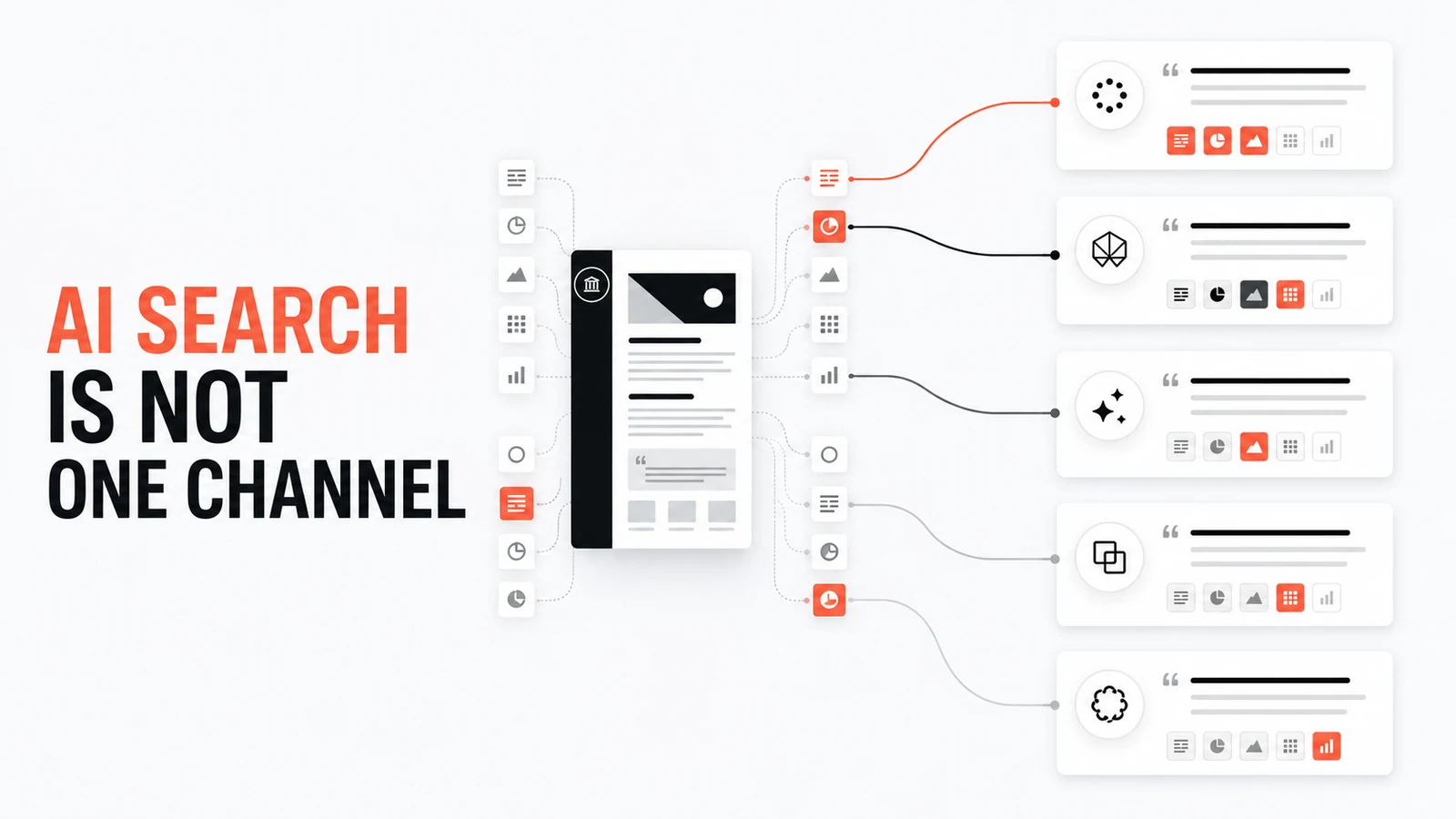
The company is therefore being evaluated in an information environment, not on one page. Its website remains important, but so do credible profiles, reviews, publications, case evidence, expert biographies, documentation and consistent business facts.
- Can the system identify the organization and distinguish it from similarly named entities?
- Can it understand what the company does, for whom and in which markets?
- Can it find evidence that supports expertise, reputation and important claims?
- Can it locate current information about services, leadership, locations and next steps?
- Do first-party and third-party sources tell a coherent story?
Source availability sets the ceiling on useful company research
A buyer can ask an excellent question and still receive a thin answer if the public evidence is thin. A company may have decades of expertise, strong client outcomes and a differentiated method, yet remain difficult to research because those facts are buried, vague or absent.
Accessibility is part of the problem. Important information may sit inside an image, a blocked page, an outdated PDF, a private portal or a JavaScript interaction that does not produce stable crawlable content. Other times, the information is technically accessible but too generic to help a system distinguish one provider from another.
This is where foundational SEO and technical hygiene continue to matter. Clear architecture, indexable pages, descriptive headings, internal links and stable source-of-truth content help both traditional search and retrieval-enabled AI systems find useful information. They do not guarantee selection, but they remove avoidable obstacles.
For a closer look at the information boundary, read What ChatGPT Can and Cannot Learn About Your Business.
Company clarity is more than repeating a brand description
Many organizations publish a polished paragraph about themselves and assume the job is finished. Buyer research requires more specific relationships: company to service, service to audience, expert to experience, location to coverage and claim to evidence.
Entity clarity grows when important facts agree across the website and credible external sources. A renamed service, acquired brand, new market or leadership change can create confusion if profiles and pages are not updated. Schema can help describe visible relationships, but markup cannot rescue contradictory or unsupported content.
Owned evidence explains
Service pages, expert biographies, case studies, methodology pages and original resources should explain what the company knows and how it works.
Third-party evidence corroborates
Relevant reviews, professional profiles, association pages, interviews, independent coverage and partner references can confirm identity, reputation and real-world experience.
Stronger reasoning does not eliminate uncertainty
OpenAI reported substantial reductions in responses containing at least one factual error on a defined internal evaluation of financial, medical and legal prompts. That is encouraging product evidence, but it is not a universal accuracy rate and should not be treated as one.
Company research remains vulnerable to stale pages, conflicting sources, ambiguous names, incomplete coverage and changing platform behavior. Search and deep-research experiences may retrieve different sources. Personalization, conversational context and the exact question can also change the response.
A polished answer can therefore be incomplete. Leadership should treat AI outputs as observable research experiences to evaluate, not as authoritative audits of market position.
What businesses should examine now
The right response is not to rewrite every page for GPT-5.6. It is to improve the evidence system that supports human and machine research.
- Define the high-value questions buyers ask before contacting the company.
- Test those questions in relevant search and AI experiences, recording the conditions and visible sources.
- Verify that core company, service, audience, location and leadership facts are current and consistent.
- Identify important claims that lack accessible evidence or third-party corroboration.
- Strengthen the pages that explain fit, differentiation, proof and next steps.
- Repeat important tests over time instead of treating one answer as a permanent result.
Better AI research raises the standard for business evidence
As research tools improve, businesses should expect buyers to ask more specific questions and compare more evidence before initiating a conversation. That can benefit companies with genuine expertise, but only when the expertise is understandable and verifiable.
The strategic advantage is not being able to say the company is optimized for GPT-5.6. It is having an evidence environment strong enough to help qualified buyers find, understand, trust and compare the company across several research surfaces.
The model will keep changing. The durable work is making the business easier to research.
Examine the evidence
What does an AI-assisted buyer find before contacting you?
The Buyer Discovery Audit examines how your company appears across search, AI answers, your website, reviews and third-party sources, then prioritizes the gaps that matter most.
Explore the Buyer Discovery Audit