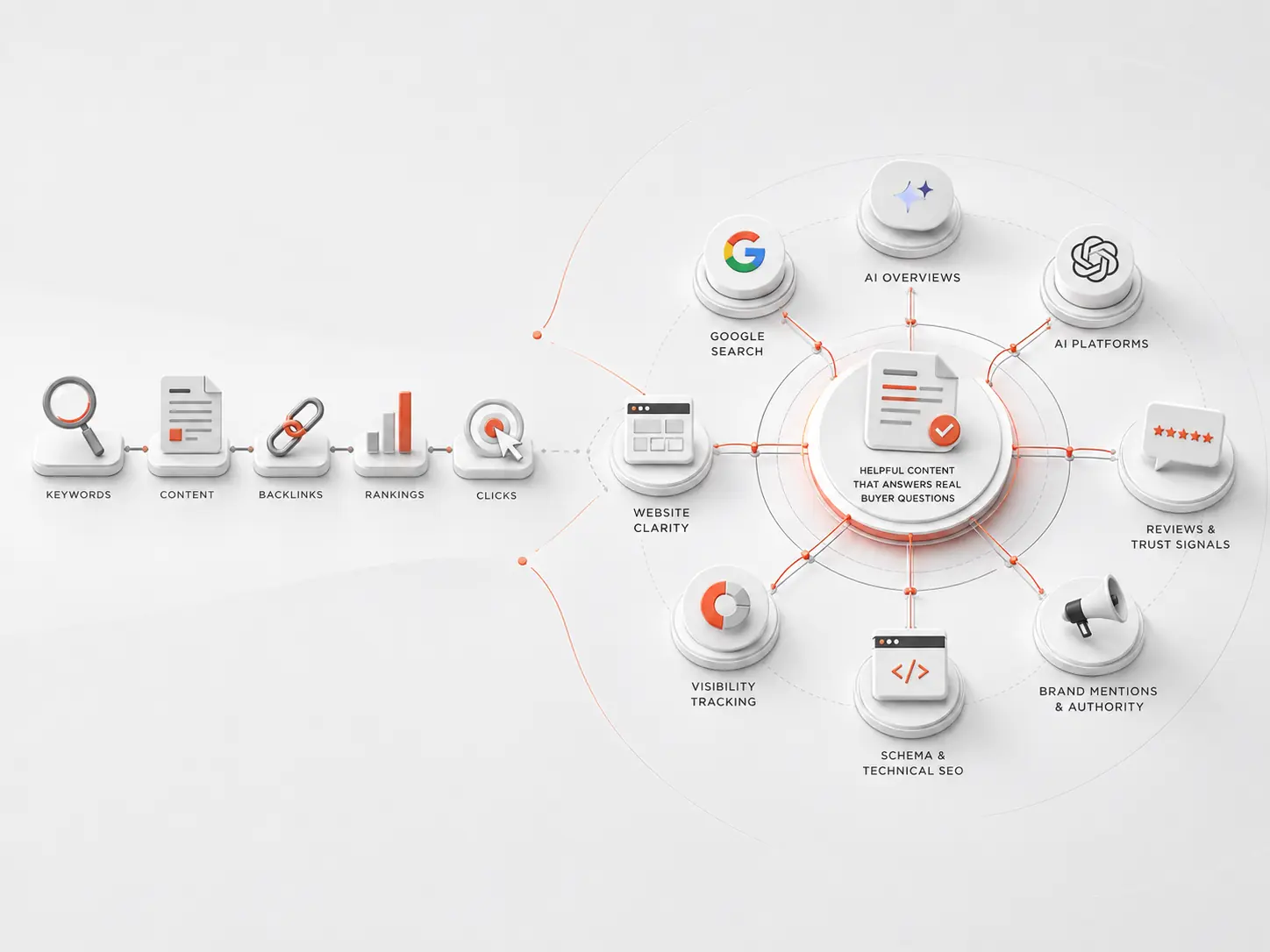
Organizations often compare a fractional search leader with an SEO agency as though they were two versions of the same vendor. They are not. One model is primarily accountable for direction and organizational alignment. The other is primarily structured to deliver work.
Confusing the roles creates predictable problems. An agency receives conflicting requests from several stakeholders. A fractional leader is expected to produce the output of an entire delivery team. Leadership pays for activity but remains unsure who owns the result.
The decision becomes easier when the company identifies whether its main constraint is leadership, execution or both.
What fractional search leadership owns
A fractional search leader operates as a senior part-time owner of the search and discoverability system. The role connects business priorities with technical SEO, content, analytics, website decisions, AI discovery, agencies and executive communication.
The value is not another set of recommendations. It is judgment about which work matters, which dependencies block progress and how teams make decisions. The leader creates the roadmap, defines standards, resolves competing priorities and holds internal and external contributors accountable.
- Strategy and roadmap ownership
- Prioritization across technical, content and authority work
- Governance, decision rights and quality standards
- Agency and specialist oversight
- Migration and major website-change guidance
- Measurement design and executive reporting
- Cross-functional coordination with product, engineering, brand and sales
What an SEO agency is built to deliver
An agency typically provides a team and a defined delivery model. Depending on the firm, that may include technical audits, content production, digital PR, link acquisition, reporting or implementation support.
Agencies work best when the organization can set priorities, grant access, make decisions and evaluate the output. A strong agency can challenge a weak brief, but it cannot permanently replace missing executive ownership inside the client organization.
The agency model can provide more production capacity than a single fractional leader. It can also create waste when the scope rewards deliverable volume instead of progress on the company’s most important constraint.
The real difference is accountability
The choice is not about prestige. It is about where accountability currently breaks. If three agencies and two internal teams are producing disconnected work, adding another execution vendor rarely solves the problem. If the strategy is coherent but the company lacks writers, technical specialists or implementation capacity, leadership alone will not close the gap.
A fractional leader should be willing to recommend less activity when the work does not support the business case. An agency should be able to deliver a clearly defined scope with reliable quality and cadence. Each model fails when it is expected to perform the other’s primary job without the necessary resources.
When the organization needs both
Complex websites, migrations, multi-market programs and high-volume content operations may require senior leadership plus specialist capacity. The fractional leader defines priorities, standards and measures. The agency or internal team executes the agreed work.
This model succeeds only when roles are explicit. The fractional leader should not become a messenger between teams, and the agency should not be asked to guess which stakeholder has final authority.
- One accountable roadmap owner
- Documented decision rights and escalation paths
- Defined agency scope and quality standards
- Shared measurement and reporting definitions
- A regular cadence for decisions, not status theater
Cost, speed and operating tradeoffs
An agency may appear more cost-effective when the comparison is based on the number of people assigned. That is useful only if the company needs those people’s output. A fractional leader may appear expensive by the hour but less expensive than months of disconnected production or a premature senior hire.
Speed also depends on the constraint. Agencies can scale production quickly, but approvals and strategy gaps can slow implementation. A fractional leader can accelerate decisions, but cannot personally replace every writer, developer, analyst and digital PR specialist.
The strongest commercial comparison looks at the cost of the unresolved operating problem, not only the monthly fee.
Questions to answer before choosing
Leadership should define the operating problem before requesting proposals. The answers reveal whether the organization needs ownership, capacity or a combined model.
- Who owns the search and discoverability roadmap today?
- Who has final authority when stakeholders disagree?
- Can internal teams implement technical and content recommendations?
- Are current vendors producing work without enough direction or approval?
- Does leadership need strategic judgment or additional hands?
- Which outcomes matter, and can the team measure them?
- Is the need temporary, ongoing or tied to a major transition?
When a full-time hire is the better answer
Fractional leadership is not a permanent substitute for every internal role. A company with continuous executive-level search needs, a large delivery organization and enough work to justify a dedicated leader may be better served by a full-time hire.
A Fractional Search Leadership engagement can help define the role, stabilize the roadmap and support the hiring transition. It should not be used to avoid building internal capability when the business clearly requires it.
Choose the model that fixes the ownership gap
An agency is not automatically tactical, and a fractional leader is not automatically strategic. Quality varies in both models. The correct choice depends on scope, judgment, accountability and fit with the organization’s operating reality.
When senior direction is missing, fractional search leadership can create focus and governance. When execution is constrained, an agency or specialist team can add capacity. When both are missing, the roles should work together under one clear operating system.